
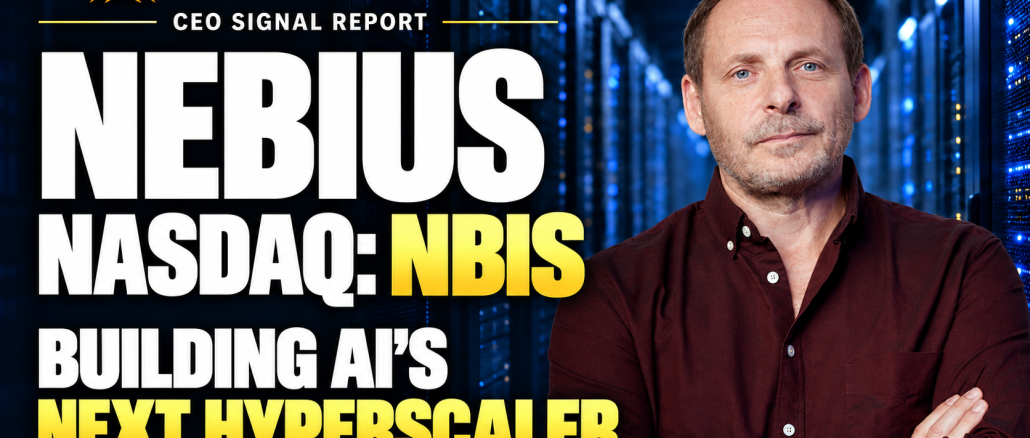
Nebius (NASDAQ: NBIS): Building AI’s Next Hyperscaler
Veterans of Russia’s Google are building an AI cloud with global ambitions. Big Tech contracts are helping finance the climb.
Published October 6, 2026 · Before fundamentals change, CEO signals often change first.

Founder & CEO · Nebius
“We want to build the engine that powers this AI revolution.”
— Arkady Volozh, Founder & CEO · Founder’s letter, 2024 annual report · Filed April 30, 2025 · Source
The mission: build the computing platform on which AI companies and enterprises train models, deploy applications, and run them at scale.
01Investment Thesis
The big bet is that Nebius can become one of the major cloud platforms of the AI era. It is selling the computing infrastructure that other companies need to train AI models, adapt them to specific tasks, and run them for users. The attraction is the chance to own a business growing into a much larger market while its scale, customer base, and earnings capacity are still taking shape.
Volozh frames the opportunity in unusually large terms: a potential trillion-dollar GPU-cloud revenue market, with a meaningful share large enough to transform Nebius. His March interview describes the ambition to join the ranks of global cloud platforms alongside AWS, Azure, and Google Cloud. The stock’s appeal is the possibility of owning that emerging franchise while it is still being built. These are the CEO’s ambitions; the company’s current revenue guidance is much smaller. [30] [31]
Why the team deserves attention: Yandex was a major search and technology company, often described as Russia’s Google. Volozh co-founded it and spent nearly three decades building a business that reached roughly $30 billion in peak valuation, according to Accel. Nebius emerged after the divestment of Yandex’s Russian operations. Its engineers bring experience with large-scale computing systems: the useful analogy is veterans of Russia’s Google building a new AI cloud. [21]
Why Nebius Matters
AI needs more than better models. It needs powerful chips working together, electricity, cooling, reliable data centers, and software that keeps those expensive machines productive. Volozh explains that large technology companies are outsourcing some capacity because they cannot expand fast enough. Nebius wants to supply that gap, then use the resulting customer relationships and financing to build a broader cloud for AI companies and enterprises. [16]
That is the connection the investment story needs: a shortage creates demand; credible execution wins large contracts; those contracts help fund more infrastructure; and the infrastructure supports a larger business. Success could materially increase future earnings. Each link still has to work for shareholders to benefit.
What Nebius Does—and What Makes It Different
Nebius is an AI-focused neocloud: a newer cloud provider built around AI computing. Its services cover model training, fine-tuning, and large-scale inference—the repeated computation required whenever a model answers a question, generates content, or performs a task. It develops its own rack designs, cloud software, and orchestration, and builds owned facilities alongside leased and partner capacity. [16] [19] [21]
| Foundation | What Nebius brings | Why an investor should care |
|---|---|---|
| Proven engineering talent | A team with years of experience building and operating cloud infrastructure. The Group’s July 2024 overview described more than 1,000 AI engineers across the Group. [23] | Experience could reduce the time and mistakes involved in building at scale. |
| Capital and a Nasdaq listing | An unusual starting position for a new company: a listed parent and substantial cash. The early story included more than $2 billion of cash; financing has since expanded substantially. [24] [9] [10] | Access to capital helps turn engineering capability into operating capacity. The cost of that capital matters. |
| Full-stack in-house technology | Rack designs, cloud software, and AI services designed to work together, with NVIDIA supplying core computing technology. [16] [1] | Better utilization and workload performance could improve customer economics and returns on the fleet. |
The competitive distinction: Nebius combines an experienced team with a freshly rebuilt platform focused on AI. That is more extensive than reselling GPU access. AWS, Azure, and Google Cloud serve a broader range of computing needs; they also build specialized AI infrastructure. CoreWeave also offers an integrated AI cloud. Nebius’s investment case therefore rests on superior execution and customer economics, rather than full-stack ownership alone. [20] [26]
Why the Stock Attracts So Much Attention
Large customers make the opportunity tangible. Microsoft’s agreement has a base value of approximately $17.4 billion, potentially rising to $19.4 billion, subject to deployment and availability. The expanded Meta agreement comprises $12 billion of dedicated capacity starting in early 2027 and up to $15 billion of additional available capacity over five years. Meta can purchase capacity Nebius does not sell to its broader cloud customers. These are multi-year values. [3] [5]
NVIDIA adds strategic credibility and capital. Its March 2026 partnership includes a $2 billion investment, engineering cooperation, and an ambition to enable more than 5 GW of NVIDIA-system deployment by the end of 2030. That helps explain enthusiasm about Nebius’s ability to expand; it does not guarantee attractive investment returns. [1]
The growth target changes the scale investors are imagining. Management’s year-end 2026 AI-cloud revenue run-rate target is $7–$9 billion, compared with $1.25 billion at the end of 2025. That would be a 5.6–7.2-fold increase in the revenue pace. Expected recognized group revenue for 2026 is $3.0–$3.4 billion; the exit run rate is a separate measure. [7]
September coverage described a rally following announced cloud price increases, showing investor attention to pricing power as well as capacity growth. [25]
The investment question: Can Nebius turn a period of intense demand into a durable cloud franchise whose cash generation grows faster than its funding needs and share count?
02CEO Playbook — The Ambition and the Route There
The CEO’s vision has two parts: become a major AI cloud, and build the technology, customer base, and financing needed to sustain it. These quotes explain the destination and the business model behind it.
The Destination · A Fourth Hyperscaler
“Think about Nebius as a fourth hyperscaler. You do not achieve that by acting as a hardware wholesaler. You have to own the whole stack.”
— Arkady Volozh · Business Insider CEO interview · March 26, 2026 · Source
What it means: A hyperscaler is a cloud provider operating at enormous global scale, such as AWS, Microsoft Azure, or Google Cloud. Volozh is describing the kind of company he intends to build. His strategy combines physical infrastructure with cloud software and AI services, giving Nebius more ways to serve customers and retain value.
The Opportunity · A Meaningful Share of a Trillion-Dollar Market
“It’s a trillion-dollar revenue business. So to be 10% of that is not bad for a startup.”
— Arkady Volozh · Citi Global TMT Conference · September 9, 2026 · Source
What the ambition implies: Volozh is describing the potential scale of GPU-cloud revenue and the value of capturing a meaningful share. Even a fraction of that market would put Nebius on a very different scale from today. The trillion-dollar estimate and 10% discussion express his long-term vision; they are separate from the company’s current revenue guidance.
The Team · Veterans of Russia’s Google
Yandex’s history puts the founders’ experience in context. Volozh and engineers who worked together for years had already built demanding internet and cloud systems before starting Nebius. Their experience makes the scale of the ambition more credible; execution must still prove that it transfers successfully to today’s AI market. [21] [22]
The three-legged starting advantage: experienced engineers; a Nasdaq-listed company with substantial starting cash; and the ability to turn technology into customer relationships. Full-stack in-house expertise supports all three. The early Group story referred to roughly 1,000 engineers, while Accel’s December 2024 investment note described a core team of about 400. The figures have different scopes and are historical. [21] [22] [23] [24]
The early zero-debt description is also historical. By June 30, 2026, Nebius reported approximately $8.0 billion in cash and $8.55 billion in debt carrying value, before the August financing. The company now has much greater resources and financing obligations. [9] [10]
The Market · AI Is Moving Into Everyday Business
“Compute and cloud needs are vastly exceeding capacity as more industries embrace AI and companies move beyond experimentation to real-world applications.”
— Arkady Volozh · Q1 shareholder letter · May 13, 2026 · Source
What it explains: Management sees demand broadening from model experimentation into production use. Training builds and adapts models; inference runs them whenever customers use AI. Both require reliable computing, creating a larger recurring market if usage continues to expand.
The Design · Built for AI From the Beginning
“Nebius has been built for AI since day one — not adapted from a general-purpose cloud, but designed for what developers actually need”
— Arkady Volozh · NVIDIA–Nebius partnership announcement · March 11, 2026 · Excerpt · Source
What it explains: Volozh’s design priority is the AI developer’s workload. Nebius builds rack designs, orchestration, and cloud software together, aiming to keep expensive computing equipment productive. NVIDIA supplies the core accelerated computing technology. The goal is a system whose useful output and reliability justify the customer’s spending. [16] [18]
The Competitive Advantage · Software That Keeps Customers on the Platform
“a large pipeline of new software and services, which we believe will provide deep moats and differentiate Nebius from other cloud companies.”
— Arkady Volozh · Q3 shareholder letter · November 11, 2025 · Excerpt · Source
Why this goes beyond selling capacity: A competitive moat is an advantage rivals struggle to copy. Volozh is betting that customers will value the software and services around the GPUs: deploying models, managing workloads, running inference, and controlling performance and costs. Those tools could make Nebius more valuable to customers as their AI applications grow.
Token Factory adds managed model deployment and inference, while Inferize targets capacity wasted as models load and systems scale. A better platform could improve customer retention and returns across the fleet. Other providers also integrate hardware and software; durable differentiation requires evidence of better customer outcomes. [19] [12] [20] [26]
The Financing · Big Tech Helps Fund the Broader Cloud
“This contract alone can unlock billions of dollars of capital for our own multi-tenant cloud at attractive rates”
— Arkady Volozh · Q1 earnings call · May 13, 2026 · Excerpt discussing Meta · Source
What it explains: Microsoft and Meta commitments can help Nebius raise capital and fund infrastructure for a shared cloud serving many AI builders. Meta’s additional-capacity arrangement also leaves room to sell capacity to other customers, with Meta buying remaining available capacity covered by the agreement. That links major contracts to the independent cloud’s expansion. [17] [5]
The Demand · Customers Want Capacity Before It Exists
“We could sell our entire 2027 capacity on these terms today.”
— Arkady Volozh · Q2 shareholder letter · August 12, 2026 · Source
Management reported four Q2 cloud deals averaging more than $1 billion in total contract value. About 70% of Q2 deals included prepayments, covering 50–60% of associated capital spending; estimated payback for those deals was one year and ten months. That is management’s forecast, including capacity still to be built. [8]
Nebius’s published October 1 list prices show another demand signal: H200 on-demand GPU-hours rose from $4.50 to $5.40 (+20%), and H100 from $3.85 to $4.50 (about +17%). These are list rates; realized prices depend on the contracts customers sign. [27]
The Expansion Model · Put Nebius Software on Partner-Owned Infrastructure
“Our software allows partners to reach a much wider customer base with much better margins than conventional wholesale bare-metal contracts.”
— Arkady Volozh · Infrastructure-partnership model announcement · July 15, 2026 · Source
The mechanism: Partners finance and own the infrastructure and hardware. Nebius contributes systems architecture, its cloud platform, operational expertise, and access to customers. Revenue sharing, licensing, commissions, and capacity arrangements are among the contemplated structures. This gives Nebius a route to expand available computing without funding every asset itself. [6]
“We’re working with several projects like this, and this will be a non-linear way for us to grow.”
— Arkady Volozh · Goldman Sachs Communacopia + Technology Conference · September 8, 2026 · Excerpt on infrastructure partnerships · Source
What he means by faster growth: Partner capacity could supplement the facilities Nebius builds itself. At Goldman Sachs, Volozh discussed projects bringing capacity online in 2027 and later. The opportunity is to combine other owners’ power, sites, and capital with Nebius’s technology and customers. The amount and profitability of that additional capacity remain execution questions. [35]
The Next Customers · Enterprises Controlling Their Own AI
“Organizations need both the performance of large-scale AI infrastructure and control over their data and models.”
— Arkady Volozh · Palantir partnership announcement · September 8, 2026 · Source
Palantir named Nebius its preferred sovereign AI infrastructure partner. The planned integration lets eligible commercial customers use Nebius compute and inference within Palantir’s enterprise perimeter. This offers a route to companies that want control over their data and models. The announcement does not disclose guaranteed revenue. [11]
Financial Transformation · The Scale Is Changing Quickly
| Metric | Earlier period | Latest reported / target |
|---|---|---|
| Group quarterly revenue | $105.1 million · Q2 2025 | $582.3 million · Q2 2026 |
| Group adjusted EBITDA | ($21.0 million) · Q2 2025 | $236.2 million · Q2 2026 |
| GAAP operating loss | ($111.2 million) · Q2 2025 | ($175.9 million) · Q2 2026 |
| AI-cloud revenue run rate | $1.25 billion · December 2025 | $3.0 billion · June 2026 |
| AI-cloud adjusted EBITDA margin | 24% · Q4 2025 | 50% · Q2 2026 |
| 2026 year-end AI-cloud run rate | Management target | $7–$9 billion |
| 2026 recognized group revenue | Management guidance | $3.0–$3.4 billion |
Revenue growth and adjusted profitability show the operating business changing. They also explain why investors look beyond its current size. ARR means the last month’s AI-cloud revenue multiplied by 12; it is a revenue pace, distinct from annual revenue already earned. [7] [8] [9]
The funding reality: Q2 capital purchases were approximately $5.66 billion, versus $2.25 billion of operating cash flow, which benefited from customer advances. August brought $5.75 billion of convertible financing and an exchange of $800 million of existing notes into roughly 15.8 million shares. Growing the company and growing value per share are separate tests. [9] [10]
03CEO Signals Timeline — Recent Execution
The major management decisions within the past nine months show how Nebius is pursuing its global AI-cloud ambition.
| Period | Management move | Why it matters |
|---|---|---|
| March 2026 | NVIDIA investment and expanded Meta agreement. [1] [5] | Capital, technology cooperation, and a major customer commitment support the next stage of expansion. |
| May–June 2026 | Pennsylvania power and land secured; Eigen AI acquisition announced and completed. [37] [38] [39] | Expand physical capacity and improve inference capability at the same time. |
| July 2026 | Infrastructure-partnership model and first $775 million secured debt facility. [6] [36] | Add partner capacity and recycle contracted assets into funding for growth. |
| August 2026 | Q2 results and completed $5.75 billion convertible financing. [8] [9] [10] | Revenue and adjusted profitability scale, alongside the capital required for the buildout. |
| September–October 2026 | Palantir partnership, cloud price increases, and Inferize acquisition. [11] [12] [27] | Reach enterprise customers and seek better economics from the computing fleet. |
The progression: Win commitments → expand capacity → finance delivery → deepen the platform → broaden the customer base.
04News Flow — Major Developments
Ten developments selected for their effect on Nebius’s customer commitments, capacity, technology, financing, or earnings. The review window is January 6–October 6, 2026; the selected announcements fall between March and October. Dates below are publication dates, presented newest first. [33]
Meta and NVIDIA establish the scale of the opportunity. New capacity and financing support delivery, while acquisitions and Palantir extend the software and enterprise strategy. Q2 results provide operating evidence of the business scaling.
Weight: Arena’s editorial assessment of strategic significance, from 1 to 5. A high weight identifies a consequential development; it is not a forecast of share-price returns.
| Date | Headline & What It Signals | Type | Weight |
|---|---|---|---|
| Oct 1, 2026 | Inferize acquisition strengthens production inference
Announced: Nebius acquired technology and engineering capabilities aimed at reducing wasted computing capacity when models load and inference systems scale.
What it means: Could improve Token Factory efficiency and customer economics. The acquisition’s revenue contribution and purchase economics are not disclosed in the announcement. [12]
|
Acquisition / product | ★★★★☆ 4/5 |
| Sep 8, 2026 | Palantir partnership opens an enterprise channel
Announced: Nebius became Palantir’s preferred sovereign AI infrastructure partner, with a planned integration of compute and inference services.
What it means: Connects the cloud to enterprise customers seeking control of data and models. Distribution potential is meaningful; contracted revenue is not quantified. [11]
|
Commercial partnership | ★★★★☆ 4/5 |
| Aug 24, 2026 | Convertible financing closes at $5.75 billion
Announced: The completed offering included the additional-purchase options. Separately, $800 million of existing notes were exchanged into approximately 15.8 million shares.
What it means: Substantial funding for expansion, accompanied by debt obligations and potential dilution. This is the completed transaction introduced and priced on August 19. [10]
|
Financing — closed | ★★★★★ 5/5 |
| Aug 12, 2026 | Q2 results show the business scaling
Announced: Group revenue reached $582.3 million, up 454% year over year; adjusted EBITDA was $236.2 million. Management reiterated the $7–$9 billion year-end AI-cloud run-rate target.
What it means: The strongest operating validation in this release window. Growth and adjusted profitability rose sharply, while the GAAP operating loss and capital spending show the continuing cost of expansion. [9]
|
Earnings / guidance | ★★★★★ 5/5 |
| Jul 17, 2026 | $775 million secured facility turns contracted assets into growth capital
Announced: Nebius entered its first senior secured debt facility, backed by deployed GPUs and cash flows from an investment-grade customer; pricing was SOFR + 2.50%.
What it means: Makes the contract-to-financing mechanism tangible: existing infrastructure can support funding for the broader AI cloud. It is a repeatable financing route, with collateral and debt obligations to manage. [36]
|
Secured financing | ★★★★☆ 4/5 |
| Jul 15, 2026 | Infrastructure partnerships create another route to global expansion
Announced: Partners finance and own infrastructure and hardware; Nebius supplies its architecture, cloud software, service capabilities, and access to customers.
What it means: Could expand the cloud beyond what Nebius can finance and build alone. Licensing, revenue sharing, and other arrangements create potential software economics; execution and partner terms determine the returns. [6]
|
Expansion / business model | ★★★★☆ 4/5 |
| May 13, 2026 | Pennsylvania AI factory: power and land secured for up to 1.2 GW
Announced: Alongside Q1 results, Nebius announced a new owned Pennsylvania site with land and power secured for deployment of up to 1.2 GW.
What it means: A substantial addition to the expansion pipeline. Securing a site and power supports the hyperscaler ambition; it must still become a constructed, connected, revenue-generating facility. [37]
|
Capacity expansion | ★★★★★ 5/5 |
| May 1, 2026 | $643 million Eigen AI acquisition agreement expands inference capability
Announced: Nebius agreed to acquire Eigen AI for cash and shares valued at approximately $643 million at signing, subject to adjustments. Its model-optimization technology would strengthen Token Factory.
|
Acquisition / inference | ★★★★☆ 4/5 |
| Mar 16, 2026 | Expanded Meta agreement carries up to $27 billion of contract value
Announced: A five-year arrangement includes $12 billion of dedicated capacity starting in early 2027 and up to $15 billion of additional available capacity.
What it means: A major commercial commitment and support for expansion financing. Nebius intends to sell the additional capacity to its own cloud customers, with Meta buying covered capacity that remains available. These are multi-year values, not annual revenue. [5]
|
Major customer contract | ★★★★★ 5/5 |
| Mar 11, 2026 | NVIDIA invests $2 billion and deepens the full-stack partnership
Announced: NVIDIA committed a $2 billion investment and engineering collaboration across AI-factory design, inference, deployment, and fleet management, supporting more than 5 GW of deployment by the end of 2030.
What it means: Adds capital, technical cooperation, and access to future architectures. It strengthens the credibility of the expansion plan; the deployment ambition still requires substantial construction and financing. [1]
|
Strategic partnership / capital | ★★★★★ 5/5 |
News Flow Analysis
Strategic progression: March brought the NVIDIA investment and expanded Meta contract. May added a large capacity project and inference acquisition. July and August supplied expansion models, financing, and operating results. September and October strengthened enterprise distribution and inference efficiency.
Consistency: The developments connect directly to Volozh’s ambition: secure major customers, bring capacity online, finance the buildout, and expand the software and services customers buy. This is a coherent route toward a broader cloud franchise.
Convergence: Signed contracts, a secured site, closed financing, and completed acquisitions are concrete steps. Q2 revenue and adjusted profitability show commercial progress. New partnerships and technical capabilities still need to contribute to customer usage and cash returns.
Execution quality: The decisive measures are live capacity, delivered contracts, realized pricing, utilization, customer retention, and returns after construction and financing costs. Those determine whether the expansion creates value per share.
Upcoming Catalysts
- New capacity entering service and converting into recognized revenue on schedule.
- Progress toward the year-end $7–$9 billion AI-cloud run-rate target, alongside actual annual revenue.
- Initial delivery under the expanded Meta agreement in early 2027. [5]
- Customer usage from Palantir and efficiency gains from the inference platform.
- Realized pricing and utilization after the October 1 list-price increases.
- Returns from completed projects after debt costs, equity dilution, and hardware refresh.
05The Debate
Bull Case
- AI adoption sustains demand for computing faster than new capacity arrives.
- The team can turn a fast-growing supplier into a major cloud franchise.
- Large buyers help fund expansion and reduce uncertainty around covered capacity.
- Integrated engineering improves useful output and customer economics.
- A broader customer base and partner model extend the opportunity beyond dedicated contracts.
Bear Case
- Compute scarcity eases and pricing falls while the fleet still needs replacement.
- Construction, power, or delivery delays postpone revenue.
- Large customers eventually supply more capacity themselves.
- Competitors offer comparable performance or stronger distribution.
- Debt, dilution, and capital spending absorb the benefit of growth.
- The share price already anticipates much of the ambitious future.
The point of disagreement: Does Nebius build a lasting customer platform during the current infrastructure boom, or remain exposed to a temporary shortage? Volozh acknowledges that Big Tech can build more of its own capacity over time. The broader cloud is therefore central to the long-term case. [16]
The valuation question: A larger business is not automatically a better investment at every price. Future cash flows must justify today’s equity value after net debt, equipment replacement, and the fully diluted share count. Customer contract totals do not answer that question by themselves.
06Questions for Management
- What would demonstrate that Nebius is becoming a durable cloud franchise rather than benefiting mainly from capacity scarcity?
- How much of the next two years’ revenue depends on completed deployment milestones?
- What fraction of revenue comes from customers beyond Microsoft and Meta?
- What evidence shows better cost or performance than CoreWeave and the hyperscalers?
- What returns do completed projects earn after financing and hardware replacement?
- How much further external funding is needed, and what does that imply for dilution?
- What happens to fleet economics if GPU rental prices decline materially?
- How much revenue and capital efficiency do infrastructure partners contribute?
07Arena Signals Takeaway
Nebius is a bet that veterans of Russia’s Google can build a major global AI cloud. Its starting advantage is the combination of experienced engineers, rebuilt technology, and access to capital. Its next advantage could be converting today’s large customer commitments into the funding and scale for a broader business.
The scale of the vision explains the attention: Volozh sees a potential trillion-dollar GPU-cloud market and wants Nebius to become a major platform within it. Large contracts and strategic partners give investors concrete evidence to assess that ambition. The investment case rests on how successfully those commitments become a durable, profitable cloud platform. [30]
The decisive signal: Does each expansion create stronger customer relationships and more cash-generating capacity per share? Deployment progress, customer diversification, project returns, and financing terms will answer that more clearly than slogans about size.
What would change the view: Stronger economics and expanding customer usage strengthen the case. Falling utilization, missed deliveries, or financing needs that outrun cash returns weaken it.
Video Source Highlights
Accel Spotlight On — Building Infrastructure for the AI Era · March 11, 2025. Background on Yandex, the experienced engineering team, the founding capital position, and Nebius’s infrastructure strategy. [21] [28]
FT Future of AI Summit — Arkady Volozh on AI Infrastructure · Additional video supplied for this report, highlighting NVIDIA relationships and capacity expansion. No direct quotations or independently verified claims are drawn from this video. [29]