
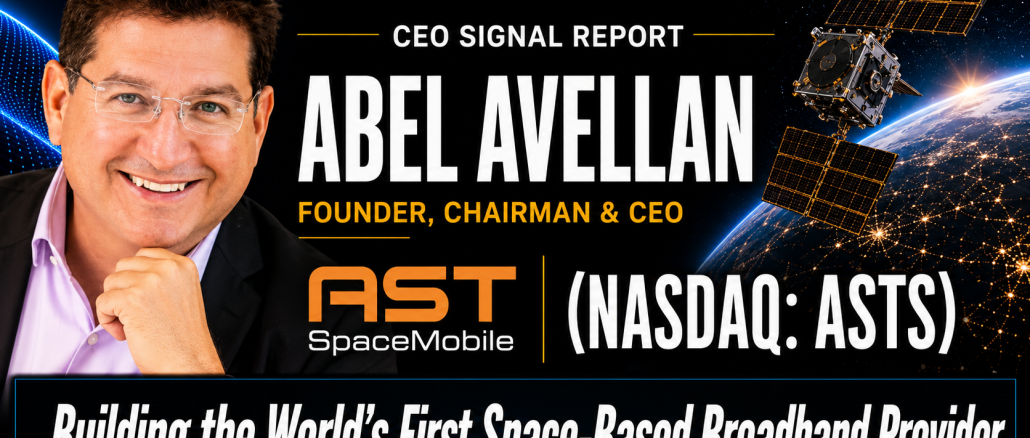
AST SpaceMobile (NASDAQ: ASTS): Building the World’s First Space-Based Broadband Provider
Arena Signals report · Direct-to-smartphone broadband · BlueBird constellation · Global carrier partnerships · Published July 15, 2026

AST SpaceMobile
01What the Company Does — In Plain English
AST SpaceMobile is building cell towers in space that connect directly to ordinary smartphones.
Today, your phone usually stops working when it moves beyond the reach of ground-based cell towers. AST’s BlueBird satellites are designed to fill those gaps by communicating directly with standard iPhones, Android phones and other cellular devices—without a satellite dish, special antenna or new handset.
AST does not plan to replace AT&T, Verizon, Vodafone or other carriers. It partners with them. When a subscriber loses terrestrial coverage, the carrier can offer AST’s satellite connection through the same phone, number and billing relationship.
In practical terms, AST is trying to make cellular coverage available in rural areas, mountains, oceans, disaster zones, transportation corridors and emerging markets where building towers is difficult or uneconomic.
02Why Now
The story has moved from “Can the technology work?” toward “Can AST manufacture, launch and commercialize it at scale?”
BlueWalker 3 demonstrated direct voice calls, 4G and 5G connectivity from space to unmodified smartphones. BlueBird 6 then deployed what AST described as the largest commercial communications array ever placed in low Earth orbit, with expected peak speeds materially above 120 Mbps.
The company generated its first meaningful revenue in 2025, secured more than $1.2 billion of contracted commercial commitments, signed definitive agreements with major carriers, expanded government work and built more than 500,000 square feet of manufacturing capacity.
The key inflection is launch density. A few satellites prove technology and provide intermittent service. Dozens of satellites begin creating a commercial network with repeated coverage across major markets.
03Investment Thesis
- The technology has crossed major validation milestones. AST has demonstrated voice, messaging and broadband directly to ordinary smartphones using carrier spectrum.
- The carrier-partner model lowers customer-acquisition friction. Agreements with more than 50 mobile-network operators provide potential access to nearly three billion subscribers.
- The addressable problem is enormous. Billions of people experience intermittent or nonexistent cellular broadband, while even developed markets contain large geographic dead zones.
- The economic prize is unusually large. Management sees a path to approximately $1 billion of annual revenue in 2027 as commercial service and government programs scale. Longer term, even modest revenue per subscriber across billions of carrier-partner subscribers could create a very large recurring infrastructure business.
- Investors are underwriting a network, not a satellite company. The valuation depends on AST becoming the wholesale satellite extension of the global wireless industry rather than selling hardware.
- AST is becoming a revenue-generating infrastructure company. Revenue increased to $70.9 million in 2025, supported by gateway deliveries, mobile-operator partners and U.S. Government milestones.
- Contracted commitments provide early demand visibility. More than $1.2 billion of partner commitments indicate that carriers are preparing to pay for commercial capacity before full constellation deployment.
- Government applications add a second major market. Tactical communications, resilient connectivity and intelligence use cases can generate revenue before consumer coverage becomes continuous.
- The mature economics could be extraordinarily attractive. Management’s original model contemplated EBITDA margins above 90% because AST uses carrier-owned spectrum and distribution rather than acquiring each subscriber directly. That remains a long-term aspiration, not current guidance.
- The largest risk is execution at industrial scale. AST must manufacture complex satellites, launch them reliably, obtain regulatory approvals, integrate with carrier networks and fund a capital-intensive deployment.
- The math that gets investors excited. Management sees the 2027 revenue opportunity approaching $1 billion annually. Longer term, the opportunity becomes much larger if AST captures only a small fraction of the global wireless market through its carrier partners. For illustration, if carrier partnerships ultimately enabled approximately 50 million subscribers generating roughly $3 per month for AST, that would equate to about $1.8 billion of recurring annual revenue. At 100 million subscribers, that figure would rise to roughly $3.6 billion annually. These are illustrative scenarios—not company forecasts—but they help explain why investors view AST as a potential communications infrastructure platform rather than simply a satellite manufacturer.
04CEO Playbook
The Mission
“We are working hard to ensure that no one becomes a second-class citizen, regardless of where they live or work, because of their lack of access to cellular broadband. For the first time in 2025, AST SpaceMobile became a revenue-generating business and significantly advanced all key aspects of our operations.”
— Abel Avellan, BlueWalker 3 launch
Avellan frames AST as a global infrastructure mission: eliminate geography as the reason a person cannot access modern communications, education, financial services or emergency assistance.
The Prize
“Our definitive commercial agreements with Verizon and stc Group are milestone achievements…as we continue to build long-term commercial relationships with industry leaders around the world, which includes agreements with over 50 MNO partners with nearly three billion subscribers globally.”
— Abel Avellan, Q3 2025 results
Arena Signals analysis: the partner model is central to the economics. AST does not need to build a consumer brand, acquire individual subscribers or purchase terrestrial spectrum in every market. Carrier partners already control the customer relationship, licensed spectrum, billing systems and distribution. AST supplies the space-based coverage layer and shares the resulting economics.
The Edge
“Achieving what many once considered impossible, we reached a pivotal milestone in our quest to deliver global cellular broadband from space.”
— Abel Avellan, after the first direct-to-smartphone voice call
Arena Signals analysis: AST is not building a messaging-only satellite service. Its large phased-array satellites are intended to function as broadband cellular towers in orbit, using carrier spectrum to communicate with ordinary, unmodified phones. The moat rests on architecture, patents, spectrum partnerships, regulatory work and the manufacturing knowledge required to repeatedly deploy very large commercial arrays.
The economic prize: management’s original model argued that the wholesale structure could eventually produce unusually high margins because AST does not need to acquire subscribers directly or own terrestrial spectrum.
“We had a very flexible and scalable super-wholesale business model…very little or no customer acquisition cost, we don’t need to own our own spectrum, and through our wholesale agreements, we get access to billions of subscribers. That allowed us to be in the 90-plus percent of EBITDA margin.”
— Abel Avellan, December 2020 public-listing presentation
Important context: this was the company’s original long-term model from 2020, not current margin guidance. The logic remains central to the bull case: after the satellites and ground infrastructure are deployed, adding subscribers should require limited customer-acquisition spending because the mobile operators provide distribution, spectrum and billing. Whether AST can ultimately approach those margins will depend on launch replacement costs, network operations, partner economics and actual usage.
The Proof
“For the first time in 2025, AST SpaceMobile became a revenue-generating business and significantly advanced all key aspects of our operations.”
— Abel Avellan, Q4 2025 results
The evidence now extends beyond laboratory tests. AST delivered gateways across five continents, generated government and carrier revenue, secured commercial prepayments and progressed multiple satellites through production and launch.
The Next Move
“We expect to scale from initial commercial activation toward the start of broader commercial service.”
— Abel Avellan, Q4 2025 results
The next move is sustained launch cadence: build enough satellites to provide useful intermittent coverage, then expand toward continuous service in the United States, Europe, Japan and other strategic markets.
05CEO Signals Timeline
The last four quarters show the story progressing from network preparation to signed commercial demand and early deployment.
“We are entering a new phase as we prepare for commercial service and accelerate manufacturing.”
Signal: Technology validation was giving way to production, gateways, launch procurement and carrier integration.
“Commercial activity has significantly accelerated, demonstrating robust demand for our solution across the ecosystem.”
Signal: Verizon and stc definitive agreements helped move the story from memoranda and strategic partnerships toward contracted economics.
“In 2026, we expect to scale our space-based direct-to-device network from initial commercial activation toward broader commercial service.”
Signal: Revenue reached $70.9 million, commitments exceeded $1.2 billion and the company set a goal of 45–60 satellites in orbit by year-end 2026.
“Our manufacturing, launch and commercial activities are converging as we move toward scaled service.”
Signal: BlueBird 7 launched, additional satellites entered the launch queue and management maintained its focus on commercial activation, contracted revenue and manufacturing scale.
06Financial Transformation
AST remains a capital-intensive development company, but the financial profile is changing rapidly as revenue, contracted commitments and liquidity expand.
| Metric | FY2023 | FY2024 | FY2025 |
|---|---|---|---|
| Revenue | Minimal | Early-stage | $70.9M |
| Contracted commercial commitments | N/A | Developing | $1.2B+ |
| Cash / restricted cash / liquidity | Build phase | Expanded | $3.9B pro forma |
| Commercial network status | Technology tests | Initial BlueBirds | Initial activation |
Q1 2026 balance-sheet caution: AST continued to use equity and convertible financing to fund spectrum rights, satellite production and launches. Class A shares outstanding increased materially year over year, and the company reported a large net loss driven partly by non-cash and financing-related items.
What the numbers say: AST has substantially reduced near-term financing risk, but investors should expect continuing capital consumption and potential dilution until recurring commercial service generates enough cash to support constellation expansion.
07Upcoming Catalysts
| Catalyst | Timing | Why It Could Move the Stock | Impact |
|---|---|---|---|
| Additional BlueBird launches | Every 1–2 months targeted | Each successful mission increases coverage capacity and reduces uncertainty around constellation deployment. | ⭐⭐⭐☆☆ |
| Commercial service activation | 2026 | The first paying subscriber traffic would validate the wholesale model and begin the transition toward recurring revenue. | ⭐⭐⭐☆☆ |
| AT&T and Verizon rollout | 2026 onward | U.S. activation would demonstrate carrier integration at national scale. | ⭐⭐⭐⭐☆ |
| 45–60 satellites in orbit | Targeted by year-end 2026 | Reaching the target would materially improve service continuity across key markets. | ⭐⭐⭐⭐☆ |
| Government and defense expansion | Ongoing | The $30 million Space Development Agency HALO Europa prime contract and additional awards could establish AST as a direct government contractor and create recurring non-consumer revenue. | ⭐⭐⭐⭐☆ |
| Revenue guidance delivery | FY2026 | Growing partner and government revenue would show that contracted commitments are converting into reported sales. | ⭐⭐⭐⭐⭐ |
08News Flow
| Date | Headline & What It Signals | Type | Weight |
|---|---|---|---|
| Jun 17 2026 | BlueBird 8–10 mission activity. Demonstrates the shift toward multi-satellite launch cadence and larger production batches. |
Launch | ★★★★★ |
| May 11 2026 | Q1 business update. Management highlighted manufacturing scale, more than $1.2 billion of commitments and progress toward commercial service. |
Financial | ★★★★★ |
| Apr 19 2026 | BlueBird 7 launched. Adds next-generation capacity and keeps the 2026 launch campaign moving. |
Launch | ★★★★★ |
| Mar 2 2026 | FY2025 revenue reaches $70.9 million. AST became a meaningful revenue-generating company and reported over $1.2 billion of contracted commitments. |
Financial | ★★★★★ |
| Mar 2026 | BlueBird 6 array fully deployed. Validated the largest and most powerful commercial communications array design in the program. |
Technology | ★★★★★ |
| Nov 10 2025 | Verizon and stc definitive agreements. Moved commercial demand from strategic intent toward contractual commitments and prepayments. |
Commercial | ★★★★★ |
| Oct 8 2025 | Verizon agreement targets U.S. geographic coverage. Creates a path to serve both leading U.S. wireless ecosystems. |
Partnership | ★★★★★ |
| 2025 | Vodafone SatCo and European expansion. Builds a unified commercial structure for direct-to-device service across Europe. |
Expansion | ★★★★ |
09The Debate
Bull Case
- AST has demonstrated broadband connectivity to ordinary smartphones.
- Carrier partnerships provide access to nearly three billion subscribers.
- More than $1.2 billion of contracted commitments validates demand.
- Large satellites may deliver materially greater broadband capacity than messaging-focused competitors.
- Government and commercial markets diversify the revenue opportunity.
- Manufacturing and launch activity are now scaling.
- The current valuation already prices in substantial execution success, leaving less room for error if launches, commercialization or adoption are delayed.
Bear Case
- The valuation assumes substantial future commercial success.
- Launch failures or satellite deployment problems could delay coverage.
- The constellation requires billions of dollars of continuing capital.
- Equity and convertible financing create dilution risk.
- Regulatory and spectrum approvals differ by country.
- Competition from SpaceX and other direct-to-device systems is intense.
10Questions for Management
- How many satellites are required for commercially useful intermittent service in the United States?
- How many are required for continuous service?
- What launch cadence is achievable through the remainder of 2026?
- What percentage of contracted commitments is expected to convert into revenue during 2026 and 2027?
- How will revenue sharing work with major mobile-network operators?
- What subscriber pricing and usage assumptions support the long-term model?
- What is the current satellite manufacturing cost, and how quickly can it decline?
- How much additional capital is required to reach continuous coverage in major markets?
- How should investors compare AST’s broadband capacity with competing direct-to-device systems?
- What milestones would demonstrate that the network has moved from deployment risk to repeatable commercial economics?