
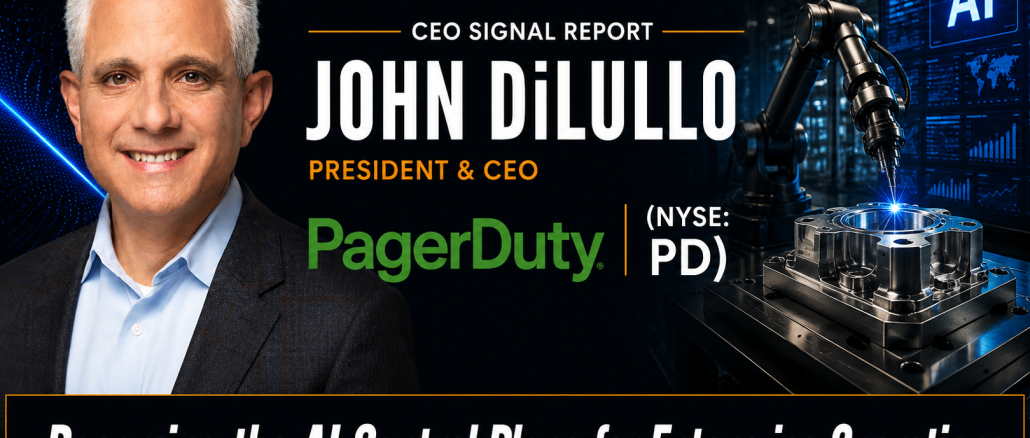
PagerDuty (NYSE: PD): Becoming the AI Control Plane for Enterprise Operations
Arena Signals report · AI-first operations · Agentic incident response · Enterprise resilience · Published July 14, 2026

PagerDuty
01What the Company Does — In Plain English
PagerDuty helps companies respond when their websites, apps, cloud systems or AI services break.
When a digital service fails, PagerDuty collects alerts from monitoring tools, determines what is important, contacts the right engineers, coordinates the response, and increasingly uses automation and AI to diagnose or fix the problem.
In simple terms, PagerDuty is the digital emergency-response system for modern businesses. Its ambition is to evolve from waking up human engineers after a failure into an AI control plane that predicts, prevents and automatically resolves operational problems.
02Why Now
AI is creating both a new growth opportunity and a new source of operational risk. Companies are deploying coding agents, enterprise copilots and autonomous systems, but every new AI service creates more software interactions, more complexity and more ways for critical systems to fail.
PagerDuty already sits inside the technology stack of thousands of enterprises, including much of the Fortune 500. If it can become the common control plane connecting monitoring tools, human teams and AI agents, the company could move from incident notification software toward a broader autonomous-operations platform.
03Investment Thesis
- PagerDuty is deeply embedded in mission-critical workflows. When digital systems fail, companies cannot simply postpone the response. PagerDuty coordinates urgent work across engineering, IT, security, customer service and executive teams.
- AI expands the strategic role of the platform. As enterprises deploy more agents and automated services, they need a trusted system that provides context, governance, orchestration and remediation across human and machine responders.
- The integration network is a potential moat. PagerDuty connects with more than 700 technology products and is expanding across over 30 AI partners, creating a shared operational context layer.
- The company has reached meaningful profitability. Fiscal 2026 was PagerDuty’s first full year of GAAP profitability, with $102.7 million in free cash flow and a 24.6% non-GAAP operating margin.
- The valuation reflects skepticism about growth. Revenue increased only 1% in Q1 fiscal 2027, ARR was flat and dollar-based net retention fell to 97%. The market is effectively asking whether AI and new pricing can restart expansion.
- The new CEO creates strategic optionality. John DiLullo has experience repositioning enterprise software and cybersecurity companies and has inherited a profitable platform with a strong balance sheet.
- The central risk is that PagerDuty remains essential but slow growing. Customers may continue using the core incident-response product without adopting enough new AI and automation products to create a meaningful reacceleration.
04CEO Playbook
The Mission
“I’ve long admired the role that the company plays at the center of modern digital operations.”
— John DiLullo, Q1 fiscal 2027 earnings call
DiLullo is beginning with the idea that PagerDuty already occupies a uniquely important position. Its technology is not a discretionary productivity tool used at convenient times. It sits inside the workflows companies activate when critical systems fail, customer experiences are threatened, and technical teams must coordinate in real time.
The Prize
“More software, more dependencies and more automation will create a greater need for resilience, orchestration and real-time operational response.”
— John DiLullo, Q1 fiscal 2027 earnings call
The opportunity expands as AI accelerates software creation and automates more business processes. Every new service, model, agent and dependency creates another potential failure point. DiLullo’s thesis is that complexity itself becomes a demand driver for PagerDuty because enterprises need one trusted layer to coordinate humans, software and automated responders.
The Edge
“What stands out to me is the strength of the foundation: a trusted brand, an enviable customer base and a platform at the core of mission-critical operations.”
— John DiLullo, Q1 fiscal 2027 earnings call
DiLullo’s edge thesis rests on trust and embeddedness. PagerDuty has years of operational history, more than 700 integrations and relationships with many of the world’s largest companies. Once the platform is integrated into escalation paths, service ownership, compliance records and incident workflows, replacing it can create meaningful operational risk.
The Proof
“I’ve been a customer multiple times. I understand firsthand the capabilities of the product and how deeply integrated it is into leading companies.”
— John DiLullo, Q1 fiscal 2027 earnings call
The new CEO is not evaluating PagerDuty only from presentations and internal reports. He previously used the platform as a customer and worked with the company as a partner. That experience gives him a direct understanding of both its practical value and the friction points that may have limited expansion.
The Next Move
“My priority is simple: listen, learn and engage…then build on the momentum already underway.”
— John DiLullo, Q1 fiscal 2027 earnings call
DiLullo is beginning with a listening tour across employees, customers and partners rather than immediately announcing a wholesale strategy change. His operating background suggests the likely focus areas will be go-to-market execution, customer expansion, adoption of usage-based Operations Cloud packaging, and clearer monetization of AI and automation.
“I think the company is perhaps underappreciated by investors. We have a great opportunity here to unlock value.”
— John DiLullo, Q1 fiscal 2027 earnings call
That may be the most important new leadership signal. DiLullo is explicitly framing PagerDuty as a value-unlock opportunity: a company with strong customers, margins, cash flow and platform relevance whose public-market valuation does not reflect its strategic position. The burden now is to prove that operational improvements can translate that position into renewed ARR growth.
05CEO Signals Timeline
The last four quarterly calls show the story moving from enterprise transformation to AI control-plane positioning, while the financial focus shifts from margin expansion toward the harder task of restarting durable ARR growth.
“As AI drives opportunity and unprecedented enterprise complexity, PagerDuty is uniquely positioned at the center of the emerging AI ecosystem.”
— Jennifer Tejada, Q2 fiscal 2026 results
Signal: Management positioned AI as both the source of new complexity and the reason PagerDuty’s real-time operations platform could become more strategically valuable.
“As enterprises scale AI, operational resilience is mission-critical.”
— Jennifer Tejada, Q3 fiscal 2026 results
Signal: PagerDuty delivered its second consecutive profitable quarter, but management acknowledged an ongoing pricing and go-to-market transition intended to support more durable growth.
“Leading agentic offerings are driving consumption growth across enterprise and AI-native segments.”
— Jennifer Tejada, Q4 fiscal 2026 results
Signal: The company finished its first profitable fiscal year and formally defined the future company as an AI operations control plane rather than only an incident-response vendor.
“The market dynamics are very favorable. AI, autonomous systems and more software dependencies create greater need for resilience, orchestration and real-time response—which PagerDuty does better than anybody else.”
— John DiLullo, Q1 fiscal 2027 earnings call
Signal: DiLullo sees a company with deep product integration, favorable AI-driven demand and a valuation he considers underappreciated. His first operating challenge is converting those advantages into stronger retention, usage and ARR growth.
06Upcoming Catalysts
| Catalyst | Timing | Why It Could Move the Stock | Impact |
|---|---|---|---|
| Q2 fiscal 2027 results | Next earnings report | The first full quarter under John DiLullo will show whether leadership changes and usage-based packaging are beginning to improve ARR, retention or pipeline quality. | ★★★★★ |
| Usage-based Operations Cloud adoption | 2026 onward | A simpler platform package could accelerate cross-sell, product engagement and consumption, addressing the company’s flat ARR and sub-100% retention. | ★★★★★ |
| AI agent monetization | 2026–2027 | Evidence that autonomous SRE, insights and scheduling agents generate incremental consumption would validate the AI control-plane thesis. | ★★★★★ |
| Enterprise retention stabilization | Quarterly | A return of dollar-based retention above 100% would indicate that customer expansion is once again exceeding contraction. | ★★★★ |
| Capital allocation and buybacks | Ongoing | Strong free cash flow and a new $100 million authorization may reduce share count and support per-share value while growth initiatives develop. | ★★★ |
07News Flow
News flow is organized from newest to oldest and evaluated against the central thesis: PagerDuty is attempting to convert its installed incident-response franchise into the control plane for AI-first enterprise operations.
| Date | Headline & What It Signals | Type | Weight |
|---|---|---|---|
| Jul 14 2026 | Alex Shootman Appointed to the Board Adds enterprise-software leadership experience as PagerDuty works to improve platform monetization and durable growth under a new CEO. |
Governance | ★★★ |
| Jun 22 2026 | Eric Prengel Appointed CFO The new CEO adds a finance leader with public-company and investment-banking experience, reinforcing focus on operational discipline, capital allocation and shareholder value. |
Leadership | ★★★★ |
| Jun 8 2026 | Australia Expansion Through Ingram Micro Extends enterprise distribution in Asia-Pacific through a scaled channel partner and supports international growth. |
Expansion | ★★★ |
| May 28 2026 | Q1 FY2027 Results and New Buyback Revenue growth slowed to 1% and ARR remained flat, but PagerDuty delivered its fourth consecutive profitable quarter, a 34% free-cash-flow margin and a new $100 million repurchase authorization. |
Financial | ★★★★★ |
| May 11 2026 | John DiLullo Appointed CEO PagerDuty begins a new operating chapter under an executive experienced in enterprise software, cybersecurity, transformation and profitable growth. |
Leadership | ★★★★★ |
| Mar 17 2026 | Study Finds Some Outages Cost More Than $1 Million Per Hour Quantifies the economic urgency behind operational resilience and supports the ROI argument for automated incident management. |
Market | ★★★★ |
| Mar 12 2026 | AI Integration Ecosystem Expanded PagerDuty connects more than 30 AI partners through MCP and direct integrations, creating a shared operational context layer for agents and human teams. |
AI Platform | ★★★★★ |
| Mar 12 2026 | Spring Operations Cloud Release Introduces a broader AI-first platform, new usage packaging and autonomous operations capabilities designed to improve time to value and consumption growth. |
Product | ★★★★★ |
08The Debate
Bull Case
- PagerDuty is entrenched in mission-critical enterprise workflows.
- AI increases operational complexity and strengthens demand for a common control plane.
- More than 700 integrations and historical incident context create a defensible platform.
- The company has reached GAAP profitability and strong free-cash-flow generation.
- A new CEO and CFO can simplify execution and reaccelerate platform adoption.
- The valuation is modest relative to revenue, cash flow and strategic position if growth returns.
Bear Case
- Q1 revenue growth was only 1% and ARR was flat.
- Dollar-based net retention declined to 97%, indicating contraction inside the customer base.
- Observability and cloud-platform vendors may absorb incident-response functionality.
- AI agents could commoditize parts of PagerDuty’s workflow rather than expand its value.
- Leadership transition and packaging changes introduce execution risk.
- Profitability may have been achieved partly by reducing investment while growth weakened.
09Questions for Management
- What are John DiLullo’s three highest priorities during his first year as CEO?
- What milestones would indicate that the usage-based Operations Cloud package is working?
- When does management expect dollar-based net retention to return above 100%?
- How much incremental ARR is currently being generated by AI agents and automation products?
- What differentiates PagerDuty’s AI control plane from observability platforms and cloud providers?
- How will PagerDuty price autonomous remediation and agentic operations?
- What percentage of large customers use more than one PagerDuty product?
- What is the long-term operating-margin target if revenue growth reaccelerates?
- How will management balance share repurchases with acquisitions and AI investment?
- What would prove that PagerDuty has evolved from incident response into mission-critical AI operations infrastructure?