
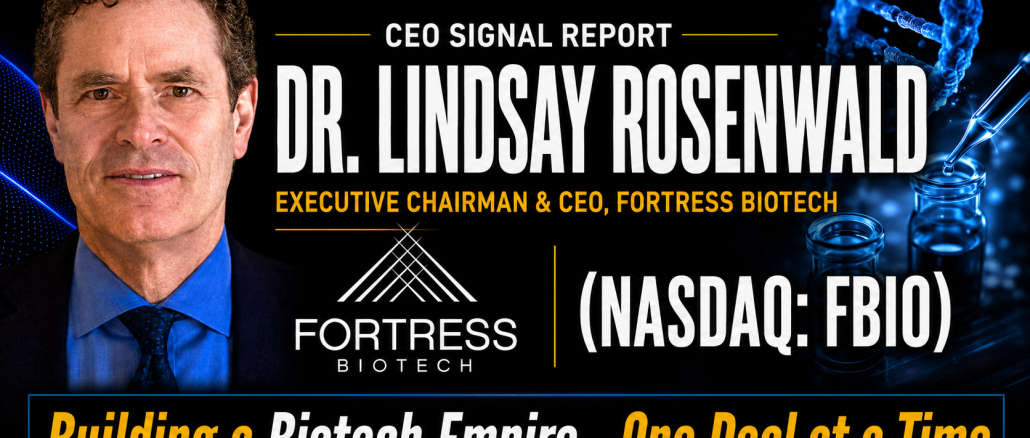
Fortress Biotech (NASDAQ: FBIO): Building a Biotech Empire—One Deal at a Time
Arena Signals report · Biotech business development · Product revenue · Equity holdings · Royalties and monetizations · Published July 20, 2026

01What the Company Does — In Plain English
Fortress Biotech is not built like a conventional single-product biotechnology company. Its strategy is to search for pharmaceutical assets that have already passed through meaningful scientific or clinical de-risking, acquire or license those assets, and place them inside focused partner companies that can finance, develop, commercialize or ultimately monetize them.
The parent company seeks to benefit through three economic channels: operating and product revenue, appreciation in its equity interests, and recurring dividends, royalties or transaction proceeds generated by partner companies. The result is a decentralized portfolio in which value can be created through product launches, FDA approvals, licensing transactions, acquisitions and sales of transferable regulatory assets.
Fortress’s current model is visible through commercial dermatology partner Journey Medical, the completed sale of Checkpoint Therapeutics, and Cyprium Therapeutics’ sale of a Rare Pediatric Disease Priority Review Voucher for $205 million following the approval of ZYCUBO for Menkes disease.
Arena Signals: The simplest way to understand Fortress is as a biotech business-development and capital-allocation platform. Its core product is not one drug. Its core capability is finding overlooked assets, creating focused companies around them, and retaining multiple ways to participate in the upside.
02Why Now
Fortress has moved from a period dominated by financing risk and development spending into a period in which several years of portfolio construction are producing tangible economic outcomes.
During the last 15 months, Fortress and its partner companies achieved FDA approvals for Emrosi, UNLOXCYT and ZYCUBO. Checkpoint Therapeutics was acquired by Sun Pharma. Cyprium then sold the ZYCUBO Priority Review Voucher for $205 million. In the first quarter of 2026, Fortress reported consolidated net income attributable to common shareholders of $108.4 million, compared with a $12.7 million loss in the prior-year period.
At the same time, Journey Medical’s commercial platform is becoming a larger operating asset. First-quarter 2026 revenue increased 21% to $16.0 million, driven by Emrosi revenue of $6.3 million compared with $2.1 million one year earlier.
“Make sure to keep enough financial resources on hand so you are prepared to invest when others may not be in the same position.”
Rosenwald’s capital-allocation philosophy is especially relevant after the recent monetizations: the strategic question is how much capital Fortress retains, how much it returns or uses to reduce obligations, and how much it deploys into the next generation of overlooked assets.
Arena Signals: Fortress is at an inflection point because the model has recently demonstrated its ability to convert regulatory progress into cash, earnings and strategic transactions. The next phase is proving that these outcomes can repeat across the portfolio rather than remain a cluster of unusually successful events.
03Investment Thesis
- The business model targets a structural capital shortage. Fortress believes the supply of credible drug candidates substantially exceeds the people and financing available to develop them.
- Fortress enters after part of the highest scientific risk has already been absorbed. Management generally favors clinical-stage, commercial-stage or internationally validated assets over ground-up discovery programs.
- Each asset can produce several layers of value. Fortress may benefit from product revenue, equity appreciation, royalties, dividends, milestones, company sales or regulatory-asset monetizations.
- Recent transactions validate the model. The Checkpoint sale and the $205 million PRV transaction are direct examples of assets progressing from acquisition and development into monetization.
- Journey Medical provides a growing commercial foundation. Emrosi and the broader dermatology portfolio create recurring product revenue that can reduce dependence on external financing and one-time transactions.
- Biotech distress can improve acquisition opportunities. Closed financing windows and strategic retrenchment may force larger or undercapitalized companies to abandon assets that Fortress can acquire on attractive terms.
- The valuation may obscure the underlying pieces. Investors must separately assess Fortress’s cash, ownership interests, royalty rights, marketed products, contingent payments and remaining development portfolio.
The central question: Can Fortress turn a series of major 2025–2026 successes into a repeatable cycle of acquisition, development and monetization while controlling dilution and parent-level capital requirements?
04CEO Playbook
The Mission — Bridge Biotech’s Capital Gap
“By our count, roughly over $350 billion is invested globally each year in biopharma R&D, and that’s still not nearly enough. There are far more quality drug candidates than there are people and capital to develop them, and that gap has grown significantly over the past couple of years.”
— Dr. Lindsay A. Rosenwald, executive feature profiling Fortress Biotech’s business model
Arena Signals: Fortress begins with the premise that biotechnology’s principal bottleneck is not a shortage of scientific ideas. It is a shortage of specialized teams, capital and operating infrastructure capable of advancing those ideas. Fortress attempts to turn that mismatch into a sourcing advantage.
The Prize — Three Channels of Shareholder Return
“Fortress doesn’t create new molecules. It leverages a large internal and external business development team to find, evaluate and primarily aims to acquire assets that have been significantly de-risked with strong clinical data and then builds companies to advance those programs. Ultimately, Fortress looks to generate shareholder returns through three channels: asset monetizations, growth in equity holdings in its partner companies and dividend and royalty revenue paid by its partner companies in return for the significant business development activities, as well as operational and strategic support, that Fortress provides.”
— Dr. Lindsay A. Rosenwald, executive feature profiling Fortress Biotech’s business model
Arena Signals: This is the clearest statement of the Fortress model. A traditional biotech must usually commercialize its own product or sell the company. Fortress deliberately constructs several potential routes to value, allowing the parent to participate even when a partner company raises capital independently or an asset is sold before full commercialization.
The Edge — Acquire What Others Leave Behind
“What we hear over and over in our current discussions with investors is an interest in identifying high-quality assets from within pharma or biotechs that can be spun out into new companies. This has been gaining in attractiveness over the last 3 years as investor focus increases on clinical-stage assets. What I find interesting about this shift is that Fortress’ strategy has been to do this since its founding.”
— Dr. Lindsay A. Rosenwald, BioTalk podcast with Locust Walk
Arena Signals: The competitive edge is organizational experience. As other investors become interested in carve-outs and clinical-stage spinouts, Fortress argues that it already has the sourcing network, legal structure and operating history required to execute this strategy repeatedly.
The Proof — Exploit Market Inefficiencies
“We capitalize on inefficiencies in the drug development market, such as acquiring drugs approved abroad but not in the US, and avoiding early-stage technologies where binary failure risk is highest. By positioning ourselves as a low-cost producer and accelerator of drug candidates, we can consistently pick up high-potential assets that larger or more constrained players have to leave behind.”
— Dr. Lindsay A. Rosenwald, BioTalk podcast with Locust Walk
Arena Signals: Recent outcomes illustrate the theory. Emrosi, UNLOXCYT and ZYCUBO reached FDA approval; Checkpoint was sold; and the ZYCUBO PRV generated $205 million in gross proceeds. These are different monetization paths arising from the same portfolio-building system.
The Next Move — Invest Through the Downturn
“The biotech markets are incredibly volatile. Given scientific, payer, stock market, and economic risks, there are frequently times when the financing window is shut. It is always important to make sure that you not only keep your spending going but can increase it to take advantage of other companies that are in distress.”
— Dr. Lindsay A. Rosenwald, executive leadership interview
Arena Signals: Fortress’s next opportunity may come from the same financing scarcity that harms the rest of small-cap biotech. The company’s challenge is to remain aggressive enough to acquire valuable assets without repeating the industry’s common mistake of expanding beyond its financial capacity.
05CEO Signals Timeline
Business development
Find clinically de-risked assets that larger companies or constrained owners cannot prioritize.
Signal: Fortress treats market dislocation as an acquisition funnel rather than only a financing threat.
Hub and spoke
Place assets inside focused partner companies with dedicated management, financing and development plans.
Signal: Decentralization isolates execution and creates separate financing and strategic options.
Clinical execution
Reduce regulatory and commercial risk through focused development and market preparation.
Signal: Three approvals in 15 months materially increased the number of economic endpoints available to Fortress.
Transactions
Convert progress into company sales, milestone payments, royalties, product revenue or transferable regulatory assets.
Signal: Checkpoint’s sale and the $205 million PRV transaction provide recent proof of the monetization phase.
Next generation
Retain sufficient liquidity to acquire assets during periods when biotech financing is scarce.
Signal: The next test is whether Fortress can compound recent wins without excessive dilution or overexpansion.
06Financial Transformation
| Metric / Event | Recent Result | Arena Signals Interpretation |
|---|---|---|
| Q1 2026 consolidated net income | $108.4 million attributable to common shareholders | Shows the earnings impact of portfolio monetization, but should not be treated as a normalized quarterly run rate. |
| Q1 2026 net revenue | $16.0 million versus $13.1 million | Commercial revenue is growing independently of one-time asset transactions. |
| Emrosi Q1 revenue | $6.3 million versus $2.1 million | A successful launch could materially strengthen Journey’s contribution and Fortress’s recurring operating base. |
| Cyprium PRV sale | $205 million gross proceeds | One of the clearest validations of Fortress’s ability to monetize regulatory value created by a partner asset. |
| Checkpoint transaction | Acquired by Sun Pharma following UNLOXCYT approval | Validates the subsidiary-sale pathway and may preserve future contingent economics. |
| Common shares outstanding | 33.2 million at March 31, 2026 | Per-share value depends on how effectively Fortress balances portfolio funding against dilution. |
Arena Signals: The financial profile is shifting from predominantly development-stage losses toward a combination of commercial revenue and episodic monetization gains. Investors should separate recurring operating performance from transaction-driven income when estimating sustainable value.
07Upcoming Catalysts
| Catalyst | What to Watch | Impact Rating |
|---|---|---|
| Emrosi commercialization | Prescription growth, refill behavior, payer access and quarterly revenue progression. | ★★★★★ |
| Journey Medical operating leverage | Whether higher Emrosi contribution improves gross profit, EBITDA and cash generation. | ★★★★☆ |
| ZYCUBO launch economics | Launch timing, patient identification, reimbursement and the financial allocation of PRV proceeds. | ★★★★★ |
| Checkpoint transaction economics | Receipt and timing of remaining cash, contingent-value or royalty-related payments. | ★★★★☆ |
| New asset acquisitions | Fortress’s ability to deploy post-monetization liquidity into clinically de-risked programs on attractive terms. | ★★★★☆ |
| Additional portfolio milestones | Regulatory submissions, trial readouts, partnerships and financing events across partner companies. | ★★★★☆ |
| Capital allocation | Debt reduction, preferred obligations, subsidiary funding, share dilution and potential shareholder returns. | ★★★★★ |
08News Flow
| Date | Development | Why It Matters | Signal Strength |
|---|---|---|---|
| May 14, 2026 | Fortress reported Q1 2026 results, including $108.4 million in net income attributable to common shareholders. | Captured the financial impact of recent portfolio monetizations and stronger commercial revenue. | ★★★★★ |
| May 13, 2026 | Journey Medical reported 21% revenue growth and $6.3 million of Emrosi revenue. | Provides early evidence that Emrosi can become the next major commercial growth engine. | ★★★★☆ |
| April 21, 2026 | Journey secured a contract with a third major group purchasing organization for Emrosi. | Expands institutional access and supports adoption in dermatology channels. | ★★★☆☆ |
| March 30, 2026 | Cyprium closed the sale of its Rare Pediatric Disease Priority Review Voucher for $205 million. | Transforms regulatory achievement into substantial cash and validates the PRV monetization pathway. | ★★★★★ |
| February 2026 | FDA approved ZYCUBO for the treatment of Menkes disease. | Created both a commercial rare-disease asset and the PRV subsequently sold by Cyprium. | ★★★★★ |
| 2025 | Checkpoint Therapeutics was sold to Sun Pharma following approval of UNLOXCYT. | Demonstrates Fortress’s ability to build and monetize a focused oncology partner company. | ★★★★★ |
| Late 2024–2025 | FDA approvals of Emrosi and UNLOXCYT expanded the number of commercial and transaction-ready portfolio assets. | Marked the transition from pipeline potential into measurable product and transaction economics. | ★★★★☆ |
09The Debate
The Bull Case
- Recent FDA approvals and monetizations validate the hub-and-spoke model.
- The $205 million PRV sale provides substantial capital relative to Fortress’s public valuation.
- Emrosi is showing meaningful early commercial growth.
- Fortress retains multiple economic interests across a diversified portfolio.
- Biotech distress may improve the quality and economics of new asset acquisitions.
- The market may undervalue the sum of cash, royalties, equity interests and commercial assets.
The Bear Case
- Recent transaction income is episodic and should not be annualized.
- The corporate structure can be difficult for investors to value and monitor.
- Partner companies may require ongoing financing and cause dilution at multiple levels.
- Commercial launches remain exposed to reimbursement, competition and execution risk.
- Portfolio diversification does not eliminate regulatory or clinical failure.
- Capital allocation after major monetizations will determine whether value compounds or leaks away.
10Questions for Management
- After the $205 million PRV sale, what amount of capital is available at Fortress and Cyprium after redemptions, obligations, taxes and transaction costs?
- How does management prioritize debt reduction, subsidiary funding, new acquisitions and potential shareholder returns?
- What commercial milestones would indicate that Emrosi is becoming a durable, high-margin growth product rather than benefiting only from initial launch stocking?
- What percentage of Fortress’s current estimated value comes from recurring product and royalty revenue versus one-time or contingent transaction payments?
- Which remaining partner-company assets have the clearest path to a transaction, approval or commercial launch over the next 12–24 months?
- How many new assets can Fortress realistically acquire and support without materially increasing parent-level dilution?
- What minimum clinical evidence and deal economics are required before Fortress acquires a new program?
- How does Fortress protect parent shareholders when partner companies raise capital at depressed valuations?
- What continuing economics does Fortress expect from the Checkpoint transaction, and what milestones could trigger additional value?
- What would demonstrate that the recent approvals and monetizations represent a repeatable portfolio cycle rather than an unusually concentrated period of success?
Sources: Fortress Biotech Q1 2026 financial results and SEC Form 10-Q; Journey Medical Q1 2026 results; Fortress corporate press releases; Dr. Lindsay A. Rosenwald executive interviews and BioTalk podcast excerpts supplied for this report. Share price and market capitalization reflect market data available July 20, 2026 and may change.
Disclosure: This report is for informational purposes only and is not investment advice. Biotechnology securities involve substantial clinical, regulatory, commercial, financing and dilution risk. Investors should conduct independent due diligence.