
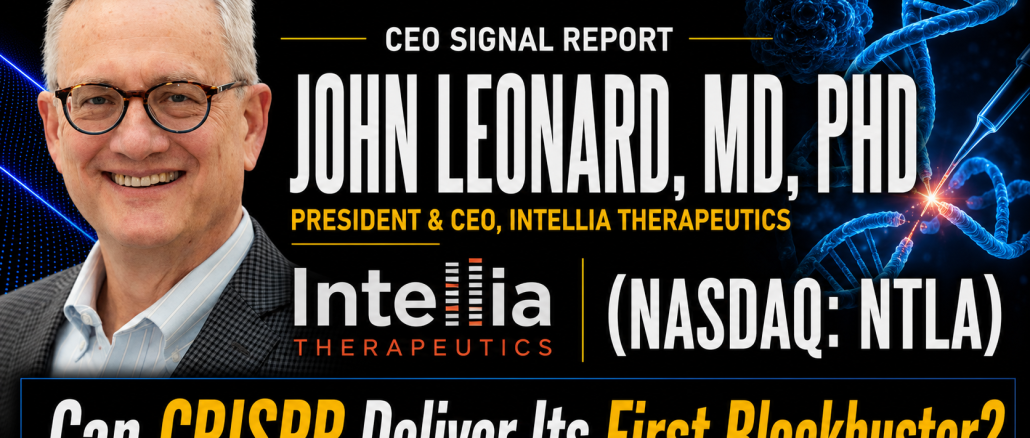
Intellia Therapeutics (NASDAQ: NTLA): Can CRISPR Deliver Its First Blockbuster?
Arena Signals report · In vivo CRISPR · One-time medicines · Hereditary angioedema · ATTR amyloidosis · Published July 22, 2026
 |
“These are the first Phase 3 results to deliver on the much-heralded promise of in vivo CRISPR gene editing.”
John Leonard, M.D. · President & Chief Executive Officer
|
01What the Company Does — In Plain English
Intellia Therapeutics is developing medicines that edit disease-causing genes directly inside the body. Its lead programs use a lipid nanoparticle to carry CRISPR machinery to the liver, where a single infusion is designed to switch off a harmful gene permanently.
The company’s most advanced asset, lonvoguran ziclumeran — known as lonvo-z and formerly NTLA-2002 — targets the KLKB1 gene in hereditary angioedema. By lowering kallikrein and bradykinin at their genetic source, Intellia is trying to replace lifelong preventive therapy with one outpatient treatment.
Its second late-stage program, nexiguran ziclumeran — nex-z — targets the TTR gene for transthyretin amyloidosis. Intellia leads development and commercialization in collaboration with Regeneron.
02Why Now
Intellia has crossed the line from scientific possibility to regulatory and commercial execution.
In April 2026, the global Phase 3 HAELO trial became the first positive Phase 3 readout for an in vivo CRISPR therapy. The trial met its primary endpoint and all key secondary endpoints. A single dose of lonvo-z reduced mean monthly HAE attacks by 87% versus placebo during the six-month evaluation period; 62% of treated patients were both attack-free and free from long-term prophylaxis, compared with 11% on placebo.
Intellia has already initiated a rolling biologics license application with the FDA and expects to complete the submission in the second half of 2026. If approved, the company anticipates a U.S. launch in the first half of 2027.
The investment debate has therefore changed. Investors are no longer waiting to learn whether in vivo CRISPR can generate a meaningful clinical effect. They are evaluating regulatory risk, launch readiness, durability, pricing, patient adoption and the safety-adjusted value of a broader platform.
03Investment Thesis
Intellia is no longer simply developing a single experimental therapy. The investment case is whether the company can become the first to build a commercially successful in vivo CRISPR platform capable of producing multiple one-time medicines across rare genetic diseases.
Its lead program, lonvo-z, targets hereditary angioedema (HAE), a multibillion-dollar market currently dominated by lifelong preventive therapies. If approved, lonvo-z would offer a fundamentally different approach: a single outpatient CRISPR treatment designed to permanently reduce disease activity rather than requiring recurring injections or daily medication. Positive Phase 3 data and a rolling BLA submission have shifted the debate from whether CRISPR works to whether physicians, patients and payers are ready to adopt a one-time genetic medicine.
Market Opportunity
- HAE is already a multibillion-dollar market supported by established blockbuster therapies.
- Existing ATTR treatments generate more than $9 billion in annual product revenue, illustrating the scale of Intellia’s next major opportunity.
- If lonvo-z succeeds commercially, investors may begin valuing Intellia as a platform company rather than a single-product biotech.
The larger opportunity extends beyond HAE. Intellia is applying the same in vivo CRISPR technology to transthyretin (ATTR) amyloidosis and additional genetic diseases. For investors, lonvo-z is more than a product launch—it is the first commercial test of whether Intellia can transform CRISPR from a scientific breakthrough into a repeatable platform capable of generating multiple future medicines.
04CEO Playbook
Mission — Get One-Time Medicines to Patients
“We are full steam ahead in achieving our mission of getting one-time therapies to more patients.”
Arena Signals Analysis: Leonard defines Intellia’s mission around the treatment experience, not around CRISPR as a scientific novelty. The objective is to replace years of injections, breakthrough attacks and treatment anxiety with a single intervention that changes the underlying biology.
That framing matters commercially. Intellia is not asking physicians and payers to value an incremental improvement. It is attempting to establish a new treatment category in which durability, freedom from chronic therapy and a simpler patient journey support the value proposition.
Prize — Redefine the HAE Treatment Landscape
“Today’s data further support our belief that lonvo-z could completely redefine the HAE treatment landscape.”
Arena Signals Analysis: The prize is larger than winning share inside the existing prophylaxis market. Lonvo-z could change how HAE is treated by shifting the goal from reducing attacks to potentially freeing patients from both attacks and ongoing preventive therapy.
If approved with a compelling label, the product could compete on an outcome that chronic therapies cannot easily replicate: one treatment with the potential for durable control. That creates the possibility of strong patient demand, premium economics and a first-mover position in one-time HAE therapy.
Edge — A Global First in Phase 3 In Vivo Editing
“These are the first Phase 3 results to deliver on the much-heralded promise of in vivo CRISPR gene editing.”
Arena Signals Analysis: Intellia’s edge is no longer merely possession of a CRISPR platform. It is the combination of systemic delivery, late-stage clinical execution and randomized Phase 3 evidence. Many competitors have credible editing science; Intellia now has the first positive Phase 3 dataset for an in vivo CRISPR candidate.
That evidence can create leverage beyond lonvo-z. Manufacturing knowledge, regulatory precedent, clinical-site experience and physician education developed for HAE may lower execution risk for future liver-directed programs.
Proof — Freedom From Attacks and Ongoing Therapy
“The promising results from HAELO reinforce our conviction that lonvo-z could revolutionize how HAE is treated for many patients.”
Arena Signals Analysis: The HAELO results supplied the proof that the strategy can work in a controlled Phase 3 setting. Lonvo-z reduced mean monthly attacks by 87% versus placebo, while 62% of treated patients were both attack-free and free from long-term prophylaxis during the evaluation period.
The most important proof point is the combination of efficacy and treatment freedom. A strong attack-rate result alone would make lonvo-z competitive; eliminating ongoing preventive therapy for many patients is what could make it category-defining.
Next Move — Turn Clinical Leadership Into a Launch
“We look forward to achieving additional important milestones during the remainder of the year.”
Arena Signals Analysis: The next move is operational: complete the rolling BLA, prepare treatment centers, educate physicians and patients, establish payer value arguments and build the infrastructure required for a targeted first-half 2027 U.S. launch.
At the same time, management must restore momentum in the nex-z program. The FDA’s lifting of both Phase 3 clinical holds returned ATTR to the development roadmap, but enhanced safety measures and the history of the liver event mean that execution must now be judged through a stricter safety lens.
05CEO Signals Timeline
The last four quarterly updates show management moving from accelerated Phase 3 execution, through a major safety setback, and then into regulatory filing and commercial-launch preparation.
“We are exceeding many of our internal expectations.”
— John Leonard, M.D., Q2 2025 results
Signal: Enrollment demand was stronger than planned across the late-stage pipeline. Management accelerated HAELO, expanded MAGNITUDE and positioned the company as moving rapidly toward its first commercial launch.
“We continue to believe in nex-z’s potential to address important unmet needs for patients with ATTR amyloidosis.”
— John Leonard, M.D., Q3 2025 results
Signal: The narrative changed abruptly after a fatal liver-related event and FDA clinical holds. Management defended the ATTR opportunity but shifted from acceleration to investigation, risk mitigation and regulatory recovery.
“2025 was a time of accomplishment and resiliency for Intellia.”
— John Leonard, M.D., Q4 and full-year 2025 results
Signal: Management framed the year around resilience: preserving the HAE launch path, beginning to reactivate MAGNITUDE-2 and working with the FDA on the cardiomyopathy study. Lonvo-z became the near-term value anchor.
“With lonvo-z, we achieved a historic milestone by presenting the world’s first Phase 3 data for an in vivo gene editing candidate and initiated a rolling BLA submission.”
— John Leonard, M.D., Q1 2026 results
Signal: Intellia moved from clinical-stage promise toward commercial execution. Positive HAELO data, a rolling BLA, resumed ATTR screening and runway into at least 2028 restored a credible path to a first-half 2027 launch.
06Upcoming Catalysts
| Expected Window | Catalyst | Why It Matters | Impact Rating |
|---|---|---|---|
| 2H 2026 | Completion of lonvo-z BLA submission | Locks in the regulatory review timeline and potential 2027 launch path. | ★★★★★ |
| Late 2026 / 2027 | FDA filing acceptance and review designation | Priority review or other expedited treatment could compress time to market. | ★★★★★ |
| 1H 2027 | Potential U.S. approval and launch of lonvo-z | Would transform Intellia into a commercial-stage company and validate in vivo CRISPR. | ★★★★★ |
| 2H 2026 | MAGNITUDE-2 enrollment completion | Re-establishes momentum in ATTRv-PN after the clinical hold. | ★★★★☆ |
| 2026–2027 | MAGNITUDE enrollment and safety updates | The cardiomyopathy opportunity is large, but safety and execution remain decisive. | ★★★★★ |
| Ongoing | Long-term durability and safety follow-up | Durability supports pricing and adoption; late safety signals could change the thesis. | ★★★★★ |
07News Flow
| Date | Development | Arena Signal | Signal Strength |
|---|---|---|---|
| Jun. 13, 2026 | Additional Phase 3 HAELO results presented; manuscript published in NEJM. | Confirmed broad endpoint strength: 87% attack reduction, 89% fewer treated attacks and 91% fewer moderate/severe attacks. | ★★★★★ |
| May 11, 2026 | Q1 results and business update. | Runway extended into at least 2028; R&D spending declined while commercial investment increased. | ★★★★☆ |
| Apr. 27, 2026 | HAELO met primary and all key secondary endpoints; rolling BLA initiated. | The defining de-risking event for lonvo-z and the in vivo CRISPR field. | ★★★★★ |
| Mar. 2, 2026 | FDA lifted MAGNITUDE clinical hold in ATTR-CM. | Restored the larger nex-z opportunity with enhanced liver monitoring and new eligibility criteria. | ★★★★☆ |
| Jan. 27, 2026 | FDA lifted MAGNITUDE-2 clinical hold in ATTRv-PN. | Allowed enrollment and dosing to resume after the 2025 safety pause. | ★★★★☆ |
| Oct. 29, 2025 | FDA placed both nex-z Phase 3 studies on clinical hold. | A severe liver event exposed the core safety risk of systemic, permanent gene editing. | ★★★★★ |
| Jun. 15, 2025 | Three-year Phase 1 lonvo-z follow-up reported. | A 98% mean attack-rate reduction and extended attack-free periods supported durability entering Phase 3. | ★★★★☆ |
08The Debate
The Bull Case
- First positive Phase 3 trial for an in vivo CRISPR therapy.
- Lonvo-z could become the first one-time treatment for HAE.
- Rolling BLA and targeted first-half 2027 launch create a visible near-term path.
- HAELO showed strong efficacy across every key endpoint with favorable reported safety.
- The same delivery platform supports a much larger ATTR opportunity.
- Cash runway into at least 2028 reduces immediate financing pressure.
The Bear Case
- Lonvo-z still faces FDA review, manufacturing and launch risk.
- Permanent editing makes long-term safety monitoring unusually important.
- The nex-z liver event and clinical holds remain a warning about platform-wide risk.
- HAE already has effective chronic therapies with established safety and reimbursement.
- One-time therapy pricing and payer acceptance may be difficult to predict.
- Commercial infrastructure will increase operating costs before meaningful product revenue arrives.
09Questions for Management
- What remaining modules and manufacturing validations must be completed before the lonvo-z BLA is fully submitted?
- How is Intellia framing the value of a one-time HAE treatment to payers relative to years of prophylactic therapy?
- What percentage of the addressable HAE population is medically and behaviorally suited for a one-time gene-editing therapy?
- What launch bottlenecks could arise around treatment-center certification, patient education and infusion capacity?
- What long-term monitoring will regulators require, and how could that affect adoption?
- How have the nex-z protocol changes altered enrollment speed, trial costs and expected completion dates?
- What evidence would management need before concluding the nex-z liver event is not a broader platform signal?
- How should investors think about economics and cost sharing with Regeneron across the ATTR franchise?
- Which additional liver-targeted diseases are best positioned to benefit from the validated delivery platform?
- At what point could commercial revenue meaningfully offset the company’s annual cash burn?