
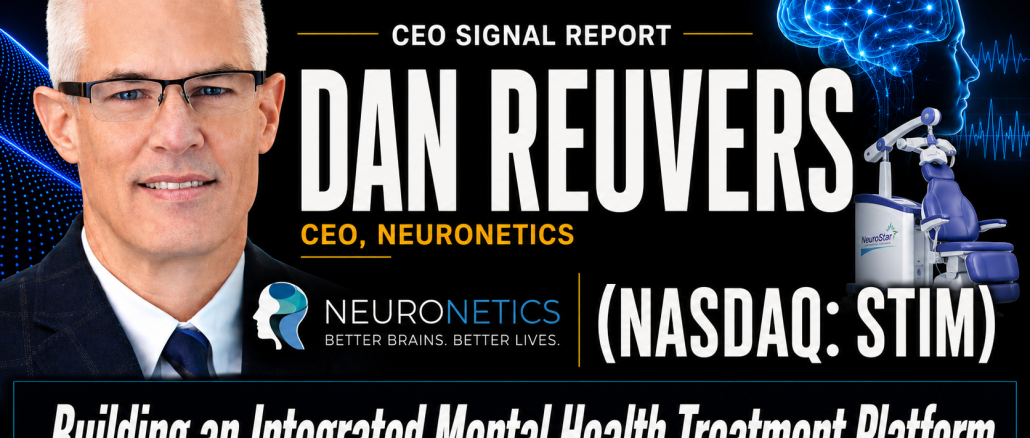
Neuronetics (NASDAQ: STIM): Building an Integrated Mental Health Treatment Platform
Arena Signals report · NeuroStar TMS · Greenbrook clinics · SPRAVATO · Cash-flow turnaround · Published July 17, 2026

Neuronetics
01What the Company Does — In Plain English
Neuronetics treats difficult mental-health conditions using both technology and its own clinic network.
Its NeuroStar system uses transcranial magnetic stimulation, or TMS, to deliver focused magnetic pulses to areas of the brain involved in mood. The patient remains awake, receives no anesthesia and can resume normal activities after treatment.
Neuronetics also owns Greenbrook treatment centers. Those clinics deliver NeuroStar TMS and administer SPRAVATO, a prescription nasal treatment for treatment-resistant depression. That means the company now earns money in three ways: selling NeuroStar systems, receiving recurring treatment-session revenue from provider customers and generating clinic revenue from care delivered inside Greenbrook locations.
In plain English, STIM is trying to become an integrated mental-health platform rather than merely a medical-device manufacturer.
02Why Now
The Greenbrook acquisition doubled the company’s scale, but investors are still waiting for proof that the combination can create sustainable cash flow.
Revenue nearly doubled in 2025 to $149.2 million, Q4 clinic revenue increased sharply and operating cash flow turned slightly positive in the fourth quarter. Q1 2026 revenue then increased 8%, while operating cash use improved by $7.6 million year over year.
Dan Reuvers became CEO in 2026 and immediately made profitability, cash management, operating discipline and strategic evaluation the central priorities. That reset creates a clearer stock-moving framework: improve clinic productivity, keep SPRAVATO growing, stabilize NeuroStar treatment revenue and prove the integrated structure can finance itself.
03Investment Thesis
- The addressable market is large and underserved. Major depression affects roughly 21 million U.S. adults, yet many patients do not respond adequately to medication.
- NeuroStar is an established category leader. More than 8.8 million treatments have been delivered to over 235,000 patients, and more than 300 million covered lives have access through insurance plans.
- Vertical integration creates multiple revenue streams. Device sales, treatment-session fees, clinic care and SPRAVATO revenue make the business less dependent on one product cycle.
- SPRAVATO provides the fastest current growth engine. Greenbrook already has the staff, reimbursement workflow and treatment infrastructure needed to scale complex neuropsychiatric therapies.
- The clinic network may become strategic infrastructure. If psilocybin or other supervised neuropsychiatric treatments receive approval, relatively few providers will possess certified sites, trained personnel and prior-authorization systems.
- The operating leverage could be meaningful. Revenue guidance implies continued growth while management targets $2.5–$3 million of annualized savings and improving cash flow through the second half.
- The valuation is low relative to revenue. At roughly $123 million of market value against $149 million of 2025 revenue, a credible path to positive cash flow could materially change the multiple.
04CEO Playbook
The Mission
“My approach has been deliberate and comprehensive, intended to allow me to fully understand this business before making decisions about where to lean in, where to adjust and how we maximize the value of what we have.”
— Dan Reuvers, Q1 2026 earnings call
Reuvers is not presenting a prepackaged turnaround plan. He is conducting an operating review of the combined NeuroStar and Greenbrook platform before deciding where capital, management attention and commercial resources can create the highest return.
The Prize
“First, on the NeuroStar side, I see a clear opportunity to broaden how we go to market and reach customer segments where we’ve not historically been positioned to compete.”
— Dan Reuvers, Q1 2026 earnings call
The prize is larger than selling more TMS systems to the company’s traditional physician base. Expanded commercial-model pilots could open new customer segments, increase placements and create more recurring treatment-session revenue across NeuroStar’s installed network.
The Edge
“With the Greenbrook clinics, workflows are key to optimizing profitability in our clinics, not only ensuring that patients have an efficient path to initiate their treatment and gain relief, but also to minimize operational handoffs.”
— Dan Reuvers, Q1 2026 earnings call
Greenbrook’s advantage is not simply the number of clinics. It is the ability to create a repeatable patient pathway—from referral and insurance authorization through treatment scheduling, delivery and reimbursement. Removing handoffs can improve patient conversion, clinic capacity and economics at the same time.
The Proof
“Revenue cycle management is also an area where I’ve spent time in my previous role. And what I’ve seen inside our clinic operations tells me there is more opportunity ahead.”
— Dan Reuvers, Q1 2026 earnings call
This may be one of the least visible but most important turnaround levers. Faster authorizations, cleaner claims, fewer denials and quicker collections can improve cash flow without requiring a major increase in patient volume. Q1 already showed lower operating expenses and substantially improved operating cash use.
The Next Move
“We have made significant strides in optimizing our operations and remain focused on disciplined execution.”
— Dan Reuvers, Q1 2026 earnings call
The next move is to convert the diagnosis into measurable results: scale the positive NeuroStar commercial pilots, improve Greenbrook workflow and revenue-cycle performance, realize $2.5–$3 million of annualized savings and reach flat-to-positive operating cash flow in the second half of 2026.
05CEO Signals Timeline
Cash management and integration became the operating priorities.
Signal: Management began demonstrating that the Greenbrook combination could reduce cash burn while maintaining growth.
Clinic growth and SPRAVATO adoption became the clearest expansion signals.
Signal: The revenue mix shifted toward owned clinics and recurring treatment delivery.
Q4 operating cash flow turned positive while clinic revenue accelerated.
Signal: The combined platform produced its strongest evidence yet that scale could improve economics.
“My approach has been deliberate and comprehensive.”
Reuvers identified three immediate operating levers: broaden NeuroStar’s go-to-market model, streamline Greenbrook’s patient workflow and improve revenue-cycle management.
Signal: The turnaround thesis evolved from broad cost control into a specific operating program aimed at expanding commercial reach, increasing clinic productivity and producing flat-to-positive second-half operating cash flow.
06Financial Transformation
| Metric | FY2024 | FY2025 | Q1 2026 |
|---|---|---|---|
| Revenue | $74.9M | $149.2M | $34.5M |
| Clinic revenue | Partial period | $87.0M | $21.5M |
| Gross margin | Legacy mix | ~48% | 46.9% |
| Operating cash flow | Negative | Q4 +$0.9M | ($9.4M) |
| Cash / restricted cash | — | $34.1M | $19.0M |
What the table says: Greenbrook doubled the revenue base and increased recurring clinic exposure, but liquidity remains the defining issue. The stock can rerate only if growth and cost savings translate into sustained cash-flow improvement.
07Upcoming Catalysts
| Catalyst | Timing | Why It Could Move the Stock | Impact |
|---|---|---|---|
| Second-half cash-flow inflection | H2 2026 | Flat-to-positive operating cash flow would directly address liquidity and going-concern concerns. | ★★★★★ |
| Expanded NeuroStar commercial pilots | 2026 | Positive pilot results could validate a broader go-to-market model and open customer segments where NeuroStar has historically had limited reach. | ★★★★☆ |
| 2026 revenue guidance delivery | Quarterly | Delivery of $160–$166 million would validate continued integration growth. | ★★★★☆ |
| Strategic review or separation decision | 2026 | A sale, separation or clarified structure could unlock a valuation gap between NeuroStar and Greenbrook. | ★★★★★ |
| SPRAVATO clinic growth | Quarterly | Continued double-digit growth would strengthen recurring clinic economics. | ★★★★☆ |
| Psilocybin approval and clinic readiness | Regulatory dependent | Greenbrook could become one of a limited number of prepared treatment networks. | ★★★★☆ |
| ANT Neuro rollout | H2 2026 | Neuronavigation may improve NeuroStar differentiation and provider adoption. | ★★★☆☆ |
08News Flow
| Date | Headline & Why It Matters | Type | Weight |
|---|---|---|---|
| June 2, 2026 | Robert Greene appointed Senior Vice President of Sales. Why It Matters: Neuronetics needs stronger NeuroStar utilization as well as new system placements. Greene’s experience in capital equipment and service-based healthcare sales makes this an important execution hire for rebuilding the commercial engine. |
Commercial leadership | ★★★☆☆ |
| June 2, 2026 | New real-world NeuroStar data presented at the Clinical TMS Society meeting. Why It Matters: The expanding evidence base can support physician adoption, payer discussions and broader treatment protocols. The adolescent and maintenance-treatment findings could also expand the long-term commercial opportunity. |
Clinical evidence | ★★★★☆ |
| May 14, 2026 | Neuronetics partners with ANT Neuro on neuronavigation. Why It Matters: MRI-guided targeting and real-time tracking could strengthen NeuroStar’s competitive position among sophisticated TMS practices. Neuronetics can introduce the technology across an already large installed base rather than building a new network from scratch. |
Product differentiation | ★★★★☆ |
| May 5, 2026 | Q1 revenue rises 8% and cash burn improves. Why It Matters: The quarter showed that Greenbrook and new system placements are supporting growth while management reduces operating cash use. The next proof point is whether these improvements carry the company toward flat-to-positive cash flow in the second half. |
Financial results | ★★★★★ |
| April 13, 2026 | Optum expands TMS access to psychiatric nurse practitioners. Why It Matters: More qualified professionals can now provide reimbursed NeuroStar treatments, expanding patient access without requiring a new product approval. A larger provider pool can translate into more treatment volume and future system placements. |
Reimbursement / access | ★★★★☆ |
| April 7, 2026 | Board responds to Pointillist Family Office. Why It Matters: The public exchange puts corporate structure and strategic alternatives into the investment thesis. Management now faces pressure to prove NeuroStar and Greenbrook are worth more together—or consider other ways to unlock value. |
Strategic review | ★★★★★ |
| April 6, 2026 | CFO transition announced; guidance reaffirmed. Why It Matters: A finance-leadership change matters when liquidity and cash-flow execution are central to the story. Reaffirmed guidance reduces immediate concern, but the permanent CFO appointment will be an important signal about financial discipline. |
Management / finance | ★★★☆☆ |
| March 17, 2026 | Dan Reuvers appointed CEO as FY2025 revenue nearly doubles. Why It Matters: Reuvers’ background in med-tech growth, direct billing and cash-flow improvement closely matches Neuronetics’ current challenge. His appointment is the foundation of the new profitability-and-execution thesis. |
CEO transition / financial | ★★★★★ |
09The Debate
Bull Case
- Revenue nearly doubled after Greenbrook.
- Clinic revenue and SPRAVATO provide recurring growth.
- NeuroStar has the largest U.S. TMS installed base.
- Cash burn is improving.
- Future therapies could increase clinic-network value.
- The valuation is below one times annual revenue.
Bear Case
- Liquidity remains tight and the company disclosed going-concern risk.
- The Greenbrook clinics carry lower gross margins.
- NeuroStar treatment revenue declined in Q1.
- Debt and future financing could dilute shareholders.
- Integration may obscure the value of the separate businesses.
- Psilocybin timing and economics remain uncertain.
10Questions for Management
- What specific milestones must be reached to achieve flat-to-positive operating cash flow in the second half?
- How much of the clinic-growth rate is driven by SPRAVATO versus TMS?
- When should NeuroStar treatment-session revenue return to sustained growth?
- What is the mature clinic-level margin target?
- How many Greenbrook sites are currently profitable?
- Does management believe NeuroStar and Greenbrook are worth more together than separately?
- What strategic alternatives are under active evaluation?
- How much additional capital could be required before cash-flow breakeven?
- How would Greenbrook participate in a potential psilocybin rollout?
- What would prove that the combined company has moved from integration to scalable profitability?