
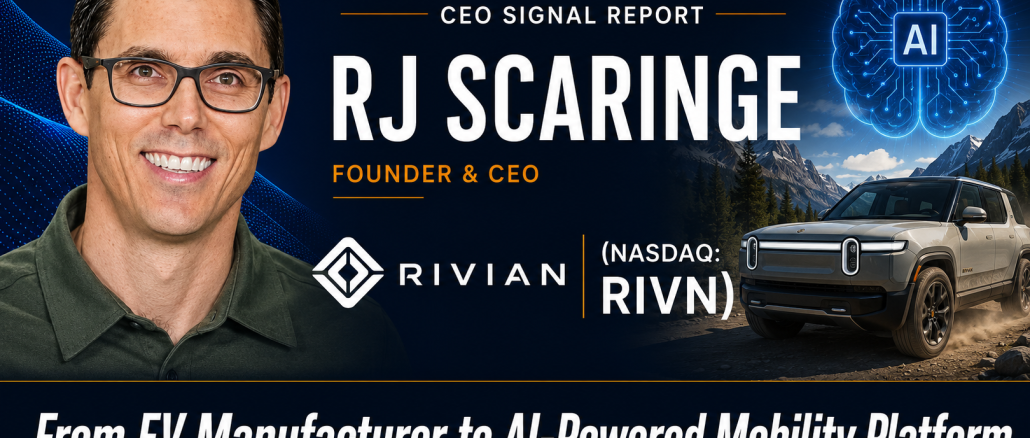
Rivian (NASDAQ: RIVN): From EV Manufacturer to AI-Powered Mobility Platform
Arena Signals report · R2 launch · Autonomy · Rivian Unified Intelligence · Volkswagen software JV · Published July 2026

Rivian Automotive
01Why Now
Rivian’s near-term inflection is R2. Its long-term valuation opportunity is autonomy. The R2 launch gives Rivian a path into a much larger market, expands the installed base for its software stack, and provides the scale needed to fund a broader AI and autonomy roadmap.
Over the last several quarters, RJ Scaringe’s language has shifted from proving that Rivian can build desirable EVs to arguing that the winners in automotive will be defined by centralized compute, zonal architecture, AI, and autonomy. R2 is the bridge from today’s vehicle business to that future platform.
02Investment Thesis
- R2 is the short-term inflection point. It moves Rivian from the premium R1 niche into the heart of the U.S. midsize SUV market and gives management a chance to prove that structural cost reductions can support profitable scale.
- Autonomy is the long-term multiple-expansion opportunity. Scaringe is explicitly telling investors that the automotive industry is becoming autonomous and AI-defined. If Rivian builds a meaningful installed base and monetizes advanced driving software, the company could be valued as more than an automaker.
- The Volkswagen JV validates the architecture. A global OEM is building around Rivian’s zonal electronics and software-defined vehicle platform, suggesting the company’s technology has external value beyond Rivian-branded vehicles.
- R2 economics fund the vision. Management expects R2’s bill of materials to be roughly half that of R1, while non-BOM costs are expected to decline materially through design simplification and volume.
- The risk remains capital and execution. Rivian’s 75 million-share offering supports the Georgia/R2 bridge but reinforces dilution concerns. The thesis depends on R2 ramping on time, margins improving, and autonomy becoming a monetizable capability rather than a permanent R&D expense.
03CEO Playbook
The Mission
“The future of the automotive industry will be fully electric, autonomous and AI defined.”
— RJ Scaringe, Q4 2025 earnings call
This is the real Rivian mission—not the marketing slogan. Scaringe is describing a future in which the vehicle becomes an AI-powered software platform. Electric propulsion is only the starting point; the strategic value shifts toward compute, data, software, autonomy, and the customer relationship after the vehicle is sold.
The Prize
“I think by 2030 it’ll be inconceivable to buy a car and not expect it to drive itself.”
— RJ Scaringe, No Priors podcast interview, February 2026
The prize is not simply selling more EVs. It is participating in a shift where autonomy becomes a standard purchase criterion and customers pay for software that gives them time back. If Rivian’s autonomy stack becomes meaningfully differentiated, every vehicle can become a recurring software and services endpoint.
The Edge
“The joint venture is developing a state-of-the-art zonal electronic architecture and functional software for Volkswagen Group and Rivian vehicles.”
— Rivian / Volkswagen Group joint venture announcement
Rivian’s edge is the software-defined vehicle foundation: centralized compute, zonal electronics, over-the-air software, cloud connectivity, and a vertically integrated autonomy stack. Volkswagen’s willingness to invest billions and deploy the architecture across multiple brands is the strongest third-party validation of that edge.
The Proof
“For R2, our bill of materials is expected to be approximately half of our R1 platform.”
— RJ Scaringe, Q1 2026 earnings call
This quote explains how Rivian intends to finance the future vision. R2 is designed around structural cost reduction, simplified manufacturing, lower component count, large castings, a structural battery pack, and next-generation drive units. The vehicle is not only a new model; it is the economic architecture for scale.
The Next Move
“I believe the R2 will be a game changer for our customers and a key driver of our long-term growth and profitability.”
— RJ Scaringe, Q1 2026 earnings call
The Next Move is to turn R2 into the installed base for Rivian’s AI strategy. Successful R2 scale means more vehicles generating data, more customers eligible for autonomy features, more software touchpoints, and a larger base over which Rivian can spread engineering and manufacturing costs.
04CEO Signals Timeline
The signal has evolved from premium EV execution to AI-defined mobility. R2 is the near-term commercial inflection; autonomy is the long-term destination.
05News Flow
News flow is organized from newest to oldest. Each item is evaluated against the central thesis: R2 builds the installed base; software and autonomy create the future platform.
| Date | Headline & What It Signals | Type | Weight |
|---|---|---|---|
| Jul 6 2026 | Rivian Commences 75 Million Share Public Offering Funding the scale bridge. Proceeds support DOE-loan equity requirements and Georgia expansion, but the transaction increases dilution and raises the execution bar. |
Financing | ★★★★ |
| Jul 2 2026 | Rivian Raises 2026 Delivery Guidance to 65,000–70,000 R2 traction and operating momentum improve the near-term setup. A larger fleet also expands the future audience for paid software and autonomy. |
Operational | ★★★★ |
| Apr 30 2026 | Q1 2026 Results Put R2 Economics at Center Stage Management details the structural cost reduction behind R2 and confirms saleable production and employee deliveries, turning the platform thesis into an execution story. |
Financial | ★★★★★ |
| Mar 27 2026 | RV Tech Completes Production-Intent SDV Winter Testing The Volkswagen JV validates Rivian’s zonal architecture across multiple brands and supports the argument that the software stack has platform value. |
Technology | ★★★★★ |
| Feb 2026 | CEO Frames 2026 as an AI, Autonomy and R2 Inflection The earnings-call message defines the Future Company: fully electric, autonomous, and AI-defined, with R2 as the mass-market platform. |
Strategy | ★★★★★ |
| Nov 2025 | Rivian/VW Joint Venture Expands Across Volkswagen Group Brands External platform validation increases. Rivian’s architecture is being prepared for Volkswagen, Audi, Scout and Rivian reference vehicles. |
Partnership | ★★★★★ |
06The Debate
Bull Case
- R2 expands Rivian’s market and creates a much larger installed base for autonomy and software.
- Volkswagen validates Rivian’s software-defined architecture as a strategic platform asset.
- Autonomy could shift Rivian’s margin profile toward recurring software revenue and higher lifetime customer value.
- If Scaringe is right that self-driving becomes a standard expectation, Rivian could be valued as an AI-enabled mobility platform rather than a conventional automaker.
Bear Case
- R2 scale and cost targets remain unproven in mass production.
- Autonomy may take longer to commercialize, face regulation, or fail to generate meaningful subscription revenue.
- The company remains capital-intensive and dilution-sensitive.
- Tesla, Waymo, legacy OEMs and Chinese competitors may outspend or out-execute Rivian in autonomy.
07Questions for Management
- What is the timeline for point-to-point autonomy and higher-level autonomous capability?
- How will Rivian monetize autonomy: upfront pricing, subscription, usage-based fees, fleet economics, or a combination?
- What percentage of the R2 installed base will have the hardware required for future autonomy upgrades?
- How does Rivian’s autonomy data advantage compare with Tesla, Waymo and Chinese OEMs?
- What role does Rivian Unified Intelligence play across product development, manufacturing, service and the customer experience?
- How much recurring software revenue per vehicle could Rivian generate at scale?
- What milestones would prove the Volkswagen JV is becoming a durable platform business?
- How quickly can R2 gross margins improve after launch?
- How much additional capital is required before Rivian reaches sustainable free cash flow?
- What would prove Rivian has crossed from EV manufacturer to AI-powered software-defined mobility platform?