
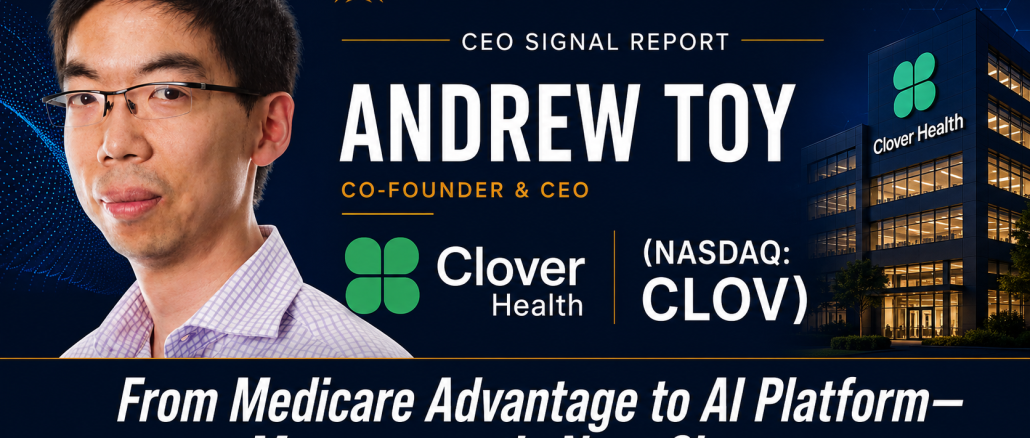
Clover Health (NASDAQ: CLOV): CEO Andrew Toy Signals the AI-Care Model Is Moving From Turnaround to Compounding Earnings Power
Arena Signals report · Medicare Advantage · Clover Assistant · Counterpart Health · Published July 2026

Clover Health
“Entering 2026, our first quarter results demonstrate how market-leading growth, GAAP Net Income profitability and full risk can scale together in Medicare Advantage.”
— Andrew Toy, CEO, Clover Health, Q1 2026 earnings call
Investment Thesis
- Clover’s management signal has changed. The company is no longer simply arguing that it can survive Medicare Advantage volatility. CEO Andrew Toy is now saying Clover can grow membership, generate GAAP profitability, and retain full underwriting economics at the same time.
- Clover Assistant is the center of the story. Management repeatedly frames the platform as the mechanism that enables earlier diagnosis, better physician engagement, improved MCR, and stronger cohort economics over time.
- Counterpart Health is the second engine. The company is using Counterpart to extend Clover Assistant beyond Clover’s owned insurance markets, creating a potential asset-light growth path if external payer and provider adoption scales.
- New Jersey density is the proof market. Management says Clover is now the largest PPO in New Jersey outside special needs and employer retiree plans, and argues that density improves provider engagement and care coordination.
- The debate is now about durability. The bull case is that Clover has built an AI-enabled Medicare Advantage model with compounding economics. The bear case is that MA regulation, Star ratings, medical cost volatility, and execution risk can still overwhelm the story.
Arena Signals is not focused on whether Clover is merely a “cheap MA stock.” The signal is whether management’s language and execution are converging around a more powerful idea: a technology-first Medicare Advantage model that improves as cohorts mature, while Counterpart Health opens a path beyond the company’s own insurance footprint.
CEO Playbook
The Mission
“We believe that this demonstrates our ability to empower physicians with technology to deliver earlier and better care, finance best-in-class benefits, drive strong retention, and strengthen our cohort economics over time.”
Toy’s mission statement is not generic healthcare language. It links care delivery, benefits, retention, and cohort economics into one operating model. The company is arguing that better care is not separate from profitability—it is the source of the economics.
The Prize
“We believe this concentration creates a virtuous cycle. Where growth drives deeper clinical integration and continued investment in core markets, reinforcing provider alignment and strengthening the underlying economics of the business over time.”
The prize is not simply adding members. It is building dense local markets where Clover Assistant can become part of the physician workflow, where members stay longer, and where medical cost improvement compounds over time.
The Edge
“Our business model is also structurally different from most Medicare Advantage plans. This is why we believe our model compounds better over time. We operate on a wide-network PPO structure where we retain full economics and generally do not delegate risk downstream.”
This is one of the most important CEO signals in the Clover story. Toy is saying the company’s structure allows it to capture the lifetime value of clinical improvement, rather than giving away economics downstream. If true, that turns Clover Assistant from software feature into economic engine.
The Proof
“When we look at our data, members who receive care from physicians using Clover Assistant show an improvement in MCR of ~8% after the first year, expanding to a ~20% MCR differential by year four.”
The proof management wants investors to focus on is cohort maturation. Clover’s argument is that new members are initially an investment, not immediate profit. As they move under Clover Assistant-powered care, the economics improve.
The Next Move
“Counterpart Health allows us to extend our model beyond our insurance footprint in an asset-light way, bringing CA-powered care to markets where we do not yet operate Medicare Advantage plans.”
The next move is Counterpart. If Clover Assistant can travel outside Clover’s own MA plan, the narrative changes. Clover would no longer be just an insurer with technology; it would become a healthcare AI operating system with an owned risk-bearing proof lab.
CEO Signals Timeline
Clover’s CEO signal has evolved across the last several quarters. The early message was stabilization: membership growth, adjusted EBITDA, utilization control, and evidence that the turnaround was real. The newer message is more ambitious: full-risk Medicare Advantage can scale with profitability, and Clover Assistant can power both the owned plan and Counterpart Health.
Toy framed the quarter as “real momentum,” pointing to membership growth, revenue growth, adjusted EBITDA expansion, and Clover Assistant’s role in better care and fewer hospital visits.
The company reported full-year adjusted EBITDA profitability and said improving cohort economics powered by Clover Assistant could drive first-ever full-year GAAP net income profitability in 2026.
The signal strengthened materially: Toy said membership growth, GAAP net income profitability, and full-risk economics can scale together.
Management used the Q&A to clarify that Clover Assistant engagement deepens over time, MCR improvement expands as cohorts mature, and Counterpart can extend the model beyond owned MA markets.
The most important change in tone is confidence. A year ago, management was proving that the model could recover. Now the message is that the model may compound. That is the Arena Signals inflection.
News Flow
The news flow supports the same direction as the CEO signal: profitability, membership growth, interoperability, and Counterpart expansion. The question for investors is whether these items remain isolated milestones or become a repeatable pattern of execution.
| DATE | HEADLINE & WHAT IT SIGNALS | TYPE | WEIGHT |
|---|---|---|---|
| May 18 2026 | Clover Health Posts Q1 2026 Investor Q&A Management lays out the core engine: Clover Assistant improves MCR as cohorts mature, Counterpart extends the model beyond owned MA markets, and equity incentives are framed around long-term shareholder value. |
Investor Communication | ★★★★★ |
| May 6 2026 | Clover Health Reports First Quarter 2026 Results Membership grew 51% year over year and the company generated GAAP net income of $27 million. This is the cleanest evidence so far that growth, profitability, and full-risk MA can scale together. |
Earnings | ★★★★★ |
| Mar 4 2026 | Clover Health Moves from Pledge to Production, Becomes the First Payer Live on a CMS-Aligned Network Interoperability moves from compliance talking point to production capability. The signal is that Clover views data access as fuel for AI-driven care, not back-office infrastructure. |
Technology | ★★★★ |
| Feb 26 2026 | Clover Health Reports Fourth Quarter & Full Year 2025 Results; Provides Full Year 2026 Guidance Full-year adjusted EBITDA profitability, 38% membership growth, and guidance for first-ever full-year GAAP net income profitability in 2026 mark the transition from turnaround story to earnings-power story. |
Financial | ★★★★★ |
| Oct 9 2025 | Clover Health Comments on 2026 Medicare Advantage Star Ratings Management says the model can perform even through rating volatility, emphasizing clinical quality and Clover Assistant over rate-driven profitability. |
Regulatory | ★★★★ |
| May 6 2025 | Clover Health Q1 2025 Earnings Call: Management Says Momentum Is Real The CEO frames early 2025 as more than enrollment growth: Clover Assistant is powering primary care, controlling utilization, and building a faster growth flywheel into 2026. |
Earnings | ★★★★ |
| Apr 2025 | Clover Releases Evidence on Clover Assistant and Congestive Heart Failure The company points to clinical impact, not just software adoption. The signal is that Clover wants investors to evaluate Clover Assistant by outcomes and cost-of-care evidence. |
Clinical Proof | ★★★★ |
| 2024–2025 | Counterpart Health Begins Expanding Clover Assistant Beyond Clover’s Own Insurance Footprint The strategic question shifts from whether Clover can improve its own MA economics to whether it can sell its AI-enabled care model to external payers and providers. |
Platform | ★★★★★ |
The Debate
Bull Case
- Clover has moved from adjusted EBITDA profitability to GAAP net income profitability while still growing membership aggressively.
- Clover Assistant may be improving MCR as cohorts mature, creating a compounding economic model.
- New Jersey density gives Clover a concentrated proof market where clinical integration is deepest.
- Counterpart Health could become an asset-light growth engine that extends Clover Assistant beyond Clover’s owned insurance footprint.
- Management’s language is increasingly confident and increasingly specific about the mechanism of value creation.
Bear Case
- Medicare Advantage remains highly regulated, politically sensitive, and exposed to rate and Star rating volatility.
- Rapid membership growth can pressure near-term MCR if new cohorts do not mature as expected.
- Counterpart Health still needs external proof at scale; inbound interest is not the same as large contracted revenue.
- Clover’s historical volatility and meme-stock legacy may cause some institutions to discount the story until execution is more consistent.
- The core question remains whether AI-driven care can produce durable cost advantages across multiple markets, not just early proof points.
Questions for Management
- How much of the current MCR improvement is directly attributable to Clover Assistant engagement versus broader market or rate dynamics?
- What percentage of members are currently receiving Clover Assistant-powered care, and what is the target by year-end?
- How should investors think about the lifetime value curve of a Clover member from year one through year four?
- Can management provide more detail on the MCR differential by cohort maturity?
- What does Counterpart Health’s pipeline look like in terms of payer versus provider opportunities?
- When should investors expect Counterpart to become financially material?
- How defensible is Clover Assistant compared with other payer AI and provider enablement platforms?
- What operational metrics best indicate that New Jersey density is translating into better provider engagement and outcomes?
- How does Clover balance membership growth against clinical integration capacity?
- What are the biggest risks to achieving full-year GAAP net income profitability?
- How would management define success for Clover Assistant and Counterpart Health over the next three years?
- What milestones should investors watch to determine whether Clover is becoming a compounding healthcare AI platform rather than a cyclical Medicare Advantage insurer?
Arena Signals Takeaway
Clover’s signal is no longer just recovery. It is the possibility that a technology-first Medicare Advantage model can scale growth, profitability, and full-risk economics together.
The central question is whether Clover Assistant and Counterpart Health can convert better data, better physician workflow, and earlier disease management into durable earnings power. If management is right, Clover is not just an MA plan. It is an AI-enabled care platform using insurance as both distribution and proof.