
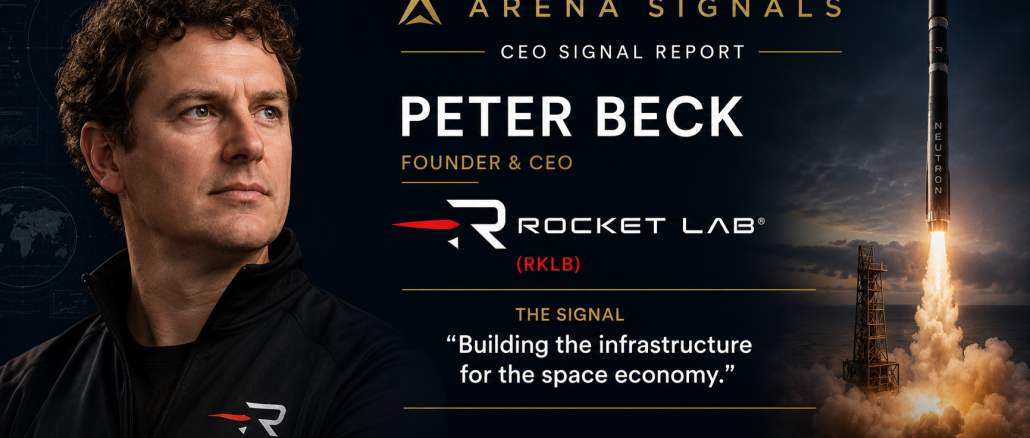
Rocket Lab (NASDAQ: RKLB): Peter Beck Signals Rocket Lab Is Building the Picks-and-Shovels Infrastructure Layer of the Space Economy
Arena Signals report · Launch services · Space systems · Satellite communications · National security space · Published July 2026

Rocket Lab
“Everything that goes to space should have a Rocket Lab logo on it.”
— Sir Peter Beck, Founder & CEO, Rocket Lab, CEO interview
01Investment Thesis
- Rocket Lab’s strongest management signal is not one quarter of revenue growth. It is Peter Beck’s long-term vision: Rocket Lab is building the picks-and-shovels infrastructure layer for the space economy.
- Beck’s interview message is that launch, satellite manufacturing, components, solar power, optical communications, spectrum, and applications are all pieces of one end-to-end platform.
- The Iridium transaction, Neutron, Space Systems growth, and recent defense wins all fit the same pattern: Rocket Lab is trying to move up the value chain from service provider to space infrastructure company.
- The last three earnings periods matter because they show whether the big-picture vision is becoming real: Q3 showed Space Systems and M&A momentum, Q4 showed record launches, SDA scale, and data-center power ambitions, and Q1 showed record revenue, backlog, and launch contract demand.
- The investor question is whether Rocket Lab can convert Beck’s infrastructure vision into durable revenue, recurring services, margin expansion, and disciplined capital allocation without overextending on Neutron, M&A, or balance-sheet risk.
02CEO Playbook
The Mission
“The plan was always to move into spacecraft… the bigger plan is to be the full end-to-end space company where we actually provide services as well.”
— Sir Peter Beck, CEO interview
This is the core Rocket Lab signal. Beck is not describing a company that merely sells launches. He is describing a company that wants to own the infrastructure chain: rockets, spacecraft, components, mission operations, communications, power systems, and eventually services layered on top of that infrastructure.
The Prize
“The large space companies of the future are going to have applications, they’re going to have the ability to build whatever satellite they need at scale, and they’re going to have unimpeded access to space.”
— Sir Peter Beck, CEO interview
“The biggest thing to be done in space hasn’t even been thought of yet.”
— Sir Peter Beck, CEO interview
The prize is not only more launches. Beck is pointing to the possibility that the most valuable space businesses will be built around applications and infrastructure that do not fully exist yet. That is why Rocket Lab’s strategy looks broader than a launch-company strategy: management wants to supply the enabling layer for whatever the next major space market becomes.
The Edge
“If you are looking to deploy large services in space, you need three things: your own rocket, the ability to build satellites at scale, and the spectrum.”
— Sir Peter Beck, CEO interview
“We said what we were going to do, and we’ve just sort of gone about systematically doing it.”
— Sir Peter Beck, CEO interview
The edge is vertical integration plus execution. Rocket Lab is trying to control the pieces that matter most for space services: launch capacity, satellite manufacturing, core components, operational know-how, and, through Iridium, spectrum and an existing communications network. Beck’s message is that the company is not trying to be a commodity launcher. It is trying to become one of the few companies with the infrastructure needed to deploy and operate space services at scale.
The Proof
“Space Systems represents about two-thirds of our revenue.”
— Sir Peter Beck, CEO interview
“We delivered record quarterly revenue of $180 million, which brought our full year revenue to a record $602 million, representing 38% growth year on year. We reached a new annual launch record, flying 21 missions across Electron and HASTE with a 100% success rate for the year.”
— Sir Peter Beck, Q4/FY 2025 results commentary
The proof is that Rocket Lab’s revenue base has already shifted beyond launch. Space Systems, SDA spacecraft, HASTE, acquisitions, optical communications, solar power products, and mission operations all support the same big-picture claim: Rocket Lab is assembling an infrastructure stack, not simply chasing launch cadence.
The Next Move
“Our intention is to launch our own stuff.”
— Sir Peter Beck, CEO interview
“Everything that goes to space should have a Rocket Lab logo on it.”
— Sir Peter Beck, CEO interview
“If this happens, you need gigawatt-scale solar power. We’ve already developed that product.”
— Sir Peter Beck, CEO interview, discussing space-based compute and orbital data-center infrastructure
The Next Move is the picks-and-shovels strategy for the space economy. Beck is not saying Rocket Lab must own every end-market. He is saying the company wants to provide the critical infrastructure those markets will need: launch, spacecraft, high-volume satellite production, power generation, communications, spectrum, components, and operations.
This is where the AI and data-center discussion becomes important. Space-based compute may or may not develop exactly as early advocates expect. But if orbital AI, space-based data centers, or large-scale space services emerge, they will require enormous power systems, launch capacity, satellite buses, communications links, and mission operations. Rocket Lab’s signal is that it wants to be the infrastructure provider for those markets before the winners are obvious.
03CEO Signals Timeline
Q3 2025: Space Systems, M&A, and defense become the platform signal
“With progress across our major space systems programs, record backlog of contracts for our launch services business, and well-timed, strategic M&A in growth areas that are well-aligned with next-generation defense programs like Golden Dome and the Space Development Agency’s future constellations, our momentum is strong and we’re poised to deliver long-term exciting growth.”
— Sir Peter Beck, Q3 2025 results commentary
The Q3 signal was not simply record revenue. It was that Rocket Lab’s acquisition strategy, Space Systems work, defense exposure, and launch backlog were converging into a broader platform narrative.
Q4 2025: The infrastructure thesis expands into satellites, Mars, Neutron, and space-based power
“It was also the quarter in which two spacecraft we built for NASA and the University of California Berkeley were successfully launched toward Mars for the historic ESCAPADE mission, proving Rocket Lab can deliver decadal class science missions on rapid timelines for a fraction of the cost of traditional interplanetary programs.”
— Sir Peter Beck, Q4/FY 2025 results commentary
Q4 broadened the message. Rocket Lab was no longer just discussing launch cadence. Management pointed to mission operations, interplanetary spacecraft, SDA satellites, Neutron qualification, optical payloads, and new solar arrays for gigawatt-scale space-based data centers. This was the quarter where the space-infrastructure story became explicit.
Q1 2026: Execution begins validating the big-picture vision
“Rocket Lab has delivered another exceptional quarter with record financial performance of more than $200 million in revenue, consistent execution across launch and space systems programs, a record number of significant new contracts signed, and strategic acquisitions secured.”
— Sir Peter Beck, Q1 2026 results commentary
Q1 is evidence, not the core story. Revenue, backlog, launch contracts, and acquisitions matter because they show the infrastructure thesis moving from interview vision to operating reality. The CEO signal has evolved from “we can launch reliably” to “we can build and operate the stack.”
04News Flow
The latest official news flow is organized reverse-chronologically. The most recent company releases appear first, because Arena Signals is tracking whether management’s narrative is strengthening or weakening in real time.
| Date | Headline & What It Signals | Type | Weight |
|---|---|---|---|
| Jul 7 2026 |
Rocket Lab Delivers Mission Success for Space Force: Completes Historic Launch and On-Orbit Satellite Tracking Mission in Record Time
VICTUS HAZE validates responsive space and on-orbit operations, strengthening the national-security execution narrative.
|
Defense | ★★★★★ |
| Jun 29 2026 |
Rocket Lab to Acquire Iridium in Historic Deal, Creating A Fully Vertically Integrated Space Powerhouse Primed for Growth
This is the major strategic pivot: Rocket Lab moves toward launch + spacecraft + spectrum + subscriber network + recurring space applications.
|
M&A | ★★★★★ |
| Jun 26 2026 |
Rocket Lab Completes 10th Consecutive Launch with 100% Mission Success for Synspective
Repeat customer cadence supports Electron reliability and shows that dedicated small launch remains a real operating franchise.
|
Customer | ★★★★ |
| Jun 25 2026 |
NASA Selects Rocket Lab to Launch Sun, Earth Sciences Missions
NASA reinforces Electron’s role as a precise, responsive science mission launcher; this supports the reliability side of the story.
|
NASA | ★★★★ |
| Jun 22 2026 |
Rocket Lab Shatters Responsive Space Record: Launches U.S. Space Force VICTUS HAZE Mission in 16 Hours 42 Minutes
Responsive launch becomes a concrete differentiator, especially for defense customers who need rapid space access.
|
Operational | ★★★★★ |
| Jun 12 2026 |
Rocket Lab To Join The Nasdaq-100 Index
Index inclusion is not an operating milestone, but it signals scale, liquidity, and institutional relevance.
|
Market | ★★★ |
05The Debate
Bull Case
- Rocket Lab is evolving into one of the few public end-to-end space infrastructure platforms.
- Electron execution remains strong, with repeat customer wins and responsive launch proof points.
- Space Systems, national-security programs, and Iridium could create a larger, more durable revenue base than launch alone.
- Neutron could unlock medium-lift constellation deployment and improve Rocket Lab’s strategic control over its own future network ambitions.
Bear Case
- The valuation already discounts a major platform transition and leaves little room for execution mistakes.
- Iridium is transformative but large, complex, debt-financed, and subject to regulatory and shareholder approvals.
- Neutron remains a major technical and schedule risk.
- Rocket Lab may be trying to scale launch, manufacturing, M&A integration, national security programs, and satellite services simultaneously.
06Questions for Management
- What are the most important milestones investors should watch to measure whether the Iridium acquisition is progressing as planned?
- How much of Rocket Lab’s future revenue mix does management expect to come from recurring space applications versus launch and spacecraft manufacturing?
- What are the key technical gates remaining before Neutron’s first flight?
- How should investors think about long-term gross margins across Launch, Space Systems, and future satellite services?
- Does Rocket Lab intend to build proprietary constellations beyond Iridium’s next-generation network?
- How much capital will be required to refresh or expand the Iridium constellation after closing?
- What portion of the backlog is defense and national-security related?
- How should investors evaluate the risk of integrating Mynaric, Motiv, and Iridium while scaling Neutron?
- Can Rocket Lab maintain Electron cadence and reliability while management attention shifts to Neutron and Iridium?
- What is the clearest evidence that Rocket Lab is becoming a space infrastructure platform rather than a launch company with acquisitions?