
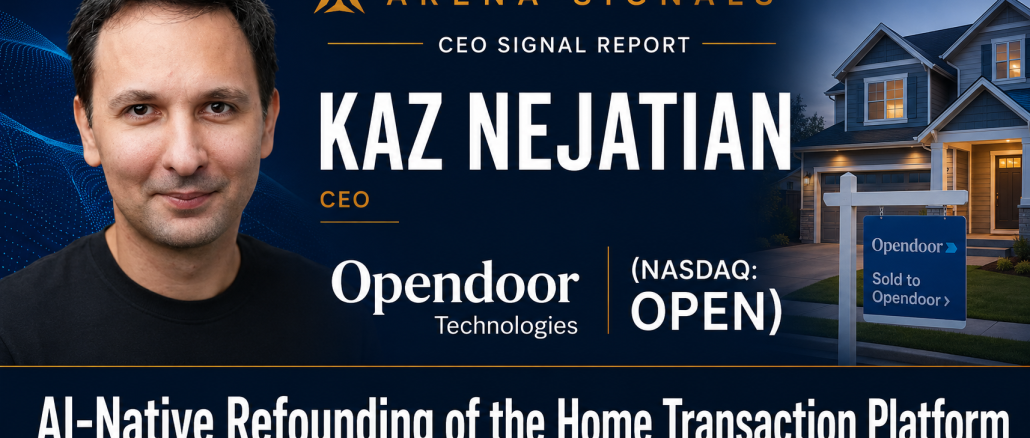
Opendoor Technologies (NASDAQ: OPEN): CEO Signals an AI-Native Refounding of the Home Transaction Platform
Arena Signals report · AI-native real estate · Opendoor 2.0 · Housing transaction platform · Published July 2026

Chief Executive Officer
Opendoor Technologies
“Few life events are as important as buying or selling a home. With AI, we have the tools to make that experience radically simpler, faster, and more certain. That’s the future we’re building.”
— Kaz Nejatian, CEO, Opendoor, CEO appointment announcement
01 Investment Thesis
- Opendoor is no longer being framed only as an iBuyer. Under Kaz Nejatian, management is attempting to refound the company as an AI-native home transaction platform built around speed, certainty and operating discipline.
- The CEO signal is centered on making the home transaction “radically simpler, faster, and more certain,” and using AI as an operating system for the business rather than a side project.
- The early proof is visible in Opendoor 2.0 cohort behavior: Q1 2026 showed stronger margin stability, resale velocity, inventory health and acquisition contract growth than prior periods.
- The strategic prize may be larger than buying and reselling homes. Nejatian’s “first derivatives” framework suggests Opendoor could eventually monetize adjacent services around mortgage, title, insurance, solar, transaction data and certainty.
- The key risk is that Opendoor remains a capital-intensive, housing-cycle-sensitive business. The turnaround requires sustained unit economics, disciplined inventory exposure and proof that AI-driven speed can scale without reviving old losses.
02 CEO Playbook
The Mission
“Few life events are as important as buying or selling a home. With AI, we have the tools to make that experience radically simpler, faster, and more certain. That’s the future we’re building.”
— Kaz Nejatian, CEO appointment announcement
The mission is not just to make home buying and selling more convenient. Nejatian is positioning Opendoor around certainty: the ability to give consumers a reliable transaction path in one of the largest and most stressful financial decisions of their lives. That framing gives the company a broader mandate than home flipping; it points toward a transaction platform.
The Prize
“Most enduring companies are built on first derivatives of their core business and not the obvious thing everyone focuses on.”
— Kaz Nejatian, Long Strange Trip / Sequoia interview summary
This is the most important long-term signal in the Opendoor story. The market tends to debate whether Opendoor can buy and resell homes profitably, but Nejatian’s framework points to a larger opportunity: once Opendoor controls the transaction relationship, it can attach adjacent services. The “first derivatives” could include mortgage, title, insurance, renovation services, solar, data products and other transaction infrastructure.
The Edge
“We’re seeing a step-function change in cohort margins, margin stability, resale velocity, and inventory health. Across those metrics, performance is among the strongest in our 10+ year operating history. These don’t all move in the same direction by accident.”
— Kaz Nejatian, Q1 2026 Open House
Opendoor’s edge is supposed to come from operating speed and pricing discipline. The company’s claim is that faster turns, better acquisition quality and healthier inventory are connected outcomes of a redesigned operating model rather than random quarterly improvement. If that is true, the business begins to look less like a housing speculation vehicle and more like a market-making platform.
The Proof
“The October cohort was just the start. A full quarter later, we’ve gone from a claim to a track record. Our 4Q25 and January 2026 cash acquisition cohorts have the best combination of margin, margin stability, and resale velocity of any corresponding cohort in company history.”
— Kaz Nejatian, Q1 2026 Open House
The proof section matters because management is explicitly arguing that Opendoor 2.0 is no longer a single-month anomaly. The company says newer cohorts are selling faster, aged inventory has been sharply reduced and resale contribution margin has improved. Those are the operational metrics investors need to track to decide whether the model is genuinely repaired.
The Next Move
“We’re focused on making the right long-term decisions to rebuild Opendoor rather than managing to short-term guidance. We’re making meaningful progress and remain focused on execution. You can continue to follow our progress on home acquisition contracts and product and feature launches every single week at accountable.opendoor.com.”
— Opendoor Q1 2026 Open House
The next move is to prove that Opendoor can scale volume without giving back margin, inventory discipline or trust. The “accountable” dashboard is part of the signal: management is trying to make execution visible in near real time. The longer-term question is whether the company can use that operating base to launch attached services and build a larger home transaction platform.
03 CEO Signals Timeline
September 2025 — AI-Native Refounding
CEO signal: Nejatian enters with a clear AI thesis: make buying and selling a home radically simpler, faster and more certain. The appointment also brings back founder DNA through Keith Rabois and Eric Wu rejoining the board.
Q4 2025 — Opendoor 2.0 Moves From Reset to Evidence
CEO signal: The company begins emphasizing acquisitions, resale velocity and cohort-level improvement. Management shifts the story from leadership change to operating evidence.
Q1 2026 — “The Machine Is Working”
CEO signal: Nejatian argues that cohort improvements are structural, not accidental. He points to stronger margins, faster turns, healthier inventory and acquisition contracts returning to levels not seen since 2022.
Long-Form Interviews — First Derivatives and Attached Services
CEO signal: The broader vision is not only to run a better iBuyer. Nejatian’s “first derivatives” framework points to a platform strategy where Opendoor monetizes adjacent services around the core home transaction.
04 News Flow
| DATE | HEADLINE & WHAT IT SIGNALS | TYPE | WEIGHT |
|---|---|---|---|
| May 2026 | Opendoor to Present at JP Morgan’s 2026 Global Technology, Media and Communications Conference Management is taking the turnaround story to institutional investors. Signal: Opendoor wants to be understood as a technology and AI operating story, not just a housing macro trade. |
Investor | ★★★ |
| May 7 2026 | Q1 2026 Open House: October Was Just The Start – Cohort After Cohort Beating On Margin & Resale Velocity While Acquisitions Accelerate This is the most important recent release. It argues that Opendoor 2.0 is repeatable across cohorts, with stronger margins, faster turns and accelerating acquisitions. Signal: management is trying to prove the new model works beyond one favorable month. |
Financial | ★★★★★ |
| Apr 16 2026 | Opendoor 1Q26 Financial Open House on May 7th, 2026 Opendoor continued its Financial Open House format with livestream and shareholder Q&A. Signal: management is deliberately building in public and trying to reset investor trust through transparency. |
IR | ★★★ |
| Feb 19 2026 | Q4 2025 Open House: Opendoor 2.0 Does What It Said It Would Do — Delivering Acquisition Growth, Faster Inventory Turns, and Stronger Cohorts The first major proof point after the Q3 reset: acquisitions increased, capital intensity improved, and inventory turns accelerated. Signal: management began shifting the conversation from survival to execution. |
Financial | ★★★★ |
| Jan 30 2026 | Opendoor 4Q25 Financial Open House: Opendoor to Report Fourth Quarter and Full Year 2025 Financial Results on February 19th, 2026 The company emphasized its commitment to investor transparency through video livestream and shareholder Q&A. Signal: the new leadership team is using communication cadence as part of the trust rebuild. |
IR | ★★★ |
| Sep 10 2025 | Opendoor Names Kaz Nejatian as CEO; Founders Rabois and Wu Rejoin Board This was the strategic reset. Signal: Opendoor moved into founder-mode governance, AI-native leadership and a board structure designed to accelerate product and operating change. |
Leadership | ★★★★★ |
05 The Debate
Bull Case
- New CEO has a clear refounding narrative: AI-native culture, faster operations, tighter inventory discipline and public accountability.
- Q1 2026 showed objective evidence of improvement: strongest contract quarter since 2022, fresher inventory, better contribution margin and improving resale velocity.
- AI is being deployed as an operating system for the business, not only as an engineering feature, which may create a faster feedback loop between field operations and software improvement.
- If Opendoor can scale first-derivative transaction services around homes, the valuation framework may shift from iBuyer to real estate transaction platform.
Bear Case
- The business remains exposed to housing cycles, mortgage rates, inventory risk and resale spreads.
- Early cohort improvement may not persist as volume grows or macro conditions worsen.
- Opendoor still must prove it can reach and sustain profitability without over-tightening acquisition volumes or taking excess balance sheet risk.
- The first-derivative opportunity is compelling, but adjacent services such as mortgage, title and transaction infrastructure remain early and unproven at scale.
06 Questions for Management
- How much of Opendoor 2.0’s cohort improvement is structural versus temporary housing-market mix?
- What acquisition volume can the company support while maintaining the target 5% to 7% contribution margin range?
- How will management prove that faster resale velocity can scale without compromising underwriting discipline?
- Which AI tools are producing measurable financial impact today, and how much of that impact is repeatable across markets?
- What percentage of transactions could eventually attach mortgage, title, escrow, insurance or other first-derivative services?
- How should investors think about Cash Plus and Cash Now, More Later as capital-light product extensions?
- What is the long-term operating expense structure required to run Opendoor 2.0 at materially larger volume?
- What role could mortgage, title and transaction infrastructure play in Opendoor’s long-term product roadmap?
- What milestones would show that Opendoor is becoming a marketplace platform rather than just a better-run iBuyer?
- How will management balance growth, margin, inventory health and cash preservation if mortgage rates remain elevated?
Sources include Opendoor investor relations press releases and Financial Open House materials, The Motley Fool Q1 2026 transcript, Colossus Business Breakdowns show notes, Sequoia Capital’s Long Strange Trip episode summary with Kaz Nejatian, Opendoor public company materials and market data as of publication. This report is for informational purposes only and is not investment advice.