
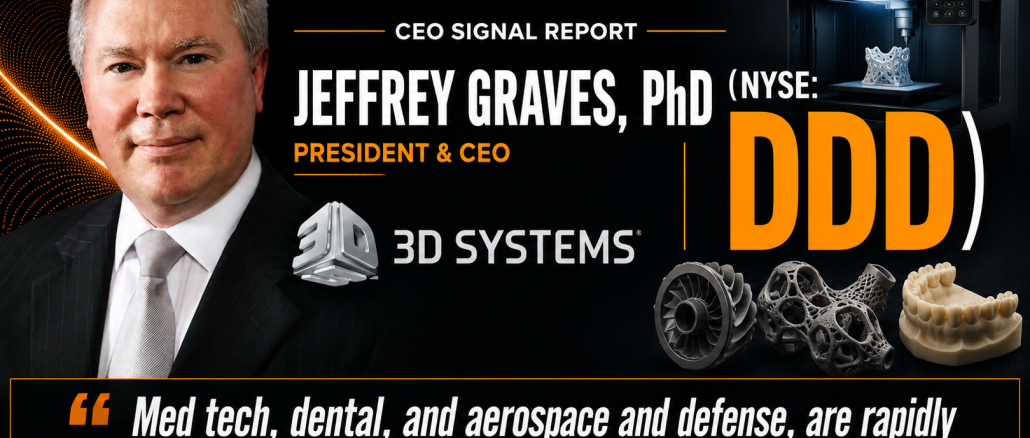
3D Systems (NYSE: DDD): “Med tech, dental, and aerospace and defense, are rapidly adopting 3D printing as a core manufacturing method.”
Arena Signals report · Production-scale additive manufacturing · Personalized healthcare · Aerospace & defense · Published July 14, 2026

3D Systems
01What the Company Does — In Plain English
3D Systems makes industrial machines, materials and software that create physical objects one thin layer at a time from a digital design.
Instead of cutting a part out of a block of metal or plastic, additive manufacturing builds the part only where material is needed. That allows engineers to create complex shapes, lighter structures, internal channels and patient-specific medical products that may be difficult or impossible to manufacture conventionally.
3D Systems sells printers, specialized materials, production software and engineering expertise. It also manufactures personalized medical devices and custom metal parts for customers in healthcare, aerospace, defense, dental and industrial markets.
02Why Now
3D Systems appears to be emerging from a difficult industry downturn with a smaller cost base, a refreshed product portfolio and renewed growth in markets where additive manufacturing has clear production value.
Q1 2026 revenue increased 11% after adjusting for divestitures, healthcare grew 21%, and adjusted EBITDA improved by roughly $28 million on a comparable basis. Dental, med tech and aerospace & defense each grew more than 20%.
The near-term opportunity is an operating recovery. The larger opportunity is that customers are moving 3D printing beyond prototypes and into repeat production of medical implants, dentures, defense components, rocket parts and other mission-critical products.
03Investment Thesis
- The business is becoming more focused. Software divestitures and cost reductions have simplified the portfolio around applications where hardware, materials, services and domain expertise work together.
- Healthcare has become a major growth engine. Personalized health services, dental systems and medical-device manufacturing produced strong double-digit growth, with healthcare revenue surpassing industrial revenue in Q1.
- Aerospace and defense is entering a production phase. Management expects approximately 20% growth in 2026 and is expanding domestic capacity for secure, qualified metal-part production.
- New printer placements create recurring revenue. Printer sales can pressure near-term gross margin, but installed systems generate future demand for proprietary materials, service and production support.
- The cost reset has changed the operating leverage. More than $55 million of annualized savings helped adjusted EBITDA swing to positive $2.1 million in Q1 from a loss of $23.9 million a year earlier.
- The company has technological optionality beyond the core business. Regenerative medicine and bioprinting could eventually create substantial value, although commercial timing remains uncertain.
- The principal risk is balance-sheet and execution pressure. The company completed a $50 million equity offering in June, and the thesis depends on converting product momentum into sustainable cash generation without repeated dilution.
04CEO Playbook
The Mission
“Digital manufacturing will play a key role in the transformation of manufacturing.”
— Dr. Jeffrey Graves, CEO appointment statement
Graves sees additive manufacturing as part of a broader shift from fixed, tool-intensive production toward digital workflows. A design can be changed in software, transmitted to another location and manufactured without creating a new mold, die or dedicated production line.
The Prize
“Three markets were particularly noteworthy: med tech, dental, and aerospace and defense, which are rapidly adopting 3D printing as a core manufacturing method.”
— Dr. Jeffrey Graves, Q4 2025 results
The company is concentrating on markets where additive manufacturing solves expensive, high-value problems. Patient-specific implants improve surgical outcomes. Printed dentures can reduce labor and turnaround time. Metal printing can produce lightweight aerospace structures, complex propulsion components and replacement parts without conventional tooling.
The Edge
“Our core strength…is our relentless application focus in meeting our customers’ most important challenges.”
— Dr. Jeffrey Graves, strategic organization announcement
3D Systems competes with one of the broadest technology portfolios in additive manufacturing: direct metal printing and five major polymer-printing platforms, paired with proprietary materials, software and application engineers. The company’s edge is not simply owning a printer technology; it is qualifying a complete workflow for regulated or demanding production applications.
The Proof
“This performance highlights the market-leading breadth of our additive manufacturing portfolio…combined with our deep expertise in advanced applications.”
— Dr. Jeffrey Graves, Q1 2026 results
In Q1, dental, med tech and aerospace & defense each grew by more than 20%. The quarter also produced positive adjusted EBITDA and a sharply narrower net loss. The key question is whether this is the beginning of a durable cycle rather than a temporary rebound after several weak years.
The Next Move
“We’re demonstrating how those investments are translating into production-focused solutions.”
— Dr. Jeffrey Graves, RAPID + TCT 2026 announcement
The next move is to turn the refreshed portfolio into installed production capacity. New high-throughput polymer systems, next-generation metal platforms and AddiTrak factory software are intended to move customers from individual machines toward connected additive-manufacturing production floors.
05CEO Signals Timeline
The last four quarterly calls show management moving from restructuring and product investment toward a production-growth narrative centered on healthcare and aerospace.
“We are focused on advancing our next generation of products while aggressively reducing our cost structure and strengthening the balance sheet.”
— Management message, Q2 2025 results
Signal: The company was still in reset mode. Revenue remained pressured, but divestitures, debt reduction and cost savings were intended to create a more focused additive-manufacturing company.
“We remain focused on driving adoption in the markets where our application expertise and technology breadth provide the greatest customer value.”
— Dr. Jeffrey Graves, Q3 2025 earnings call
Signal: The quarter remained financially weak, but management increasingly emphasized med tech, dental and aerospace as the markets capable of leading the recovery.
“These three markets have been a particular focus for our new product development over the last several years, and we believe offer sustained growth opportunities over the next decade.”
— Dr. Jeffrey Graves, Q4 2025 results
Signal: Management identified the future company more clearly. Personalized health, dental and aerospace & defense became the central growth pillars rather than simply components of a broad printer portfolio.
“As the additive manufacturing industry begins to emerge from a multi-year downturn, our sustained investments in research and development are enabling us to introduce a broad pipeline of new products that are gaining increasing customer traction.”
— Dr. Jeffrey Graves, Q1 2026 results
Signal: The turnaround thesis moved from cost reduction to growth. Core revenue increased 11%, adjusted EBITDA turned positive and new systems began gaining traction across the company’s priority markets.
06Upcoming Catalysts
| Catalyst | Timing | Why It Could Move the Stock | Impact |
|---|---|---|---|
| Q2 2026 results | Expected August 2026 | Tests whether Q1 core growth and positive adjusted EBITDA can continue after the initial rebound. | ★★★★★ |
| Full-year break-even EBITDA | FY2026 | Achieving the goal would validate the cost reset and reduce concern that future growth requires continual external capital. | ★★★★★ |
| Aerospace & defense growth | Quarterly through 2027 | A&D is expected to become the largest industrial business, supported by domestic supply-chain demand and an Air Force-funded metal platform. | ★★★★★ |
| NextDent 300 commercial ramp | 2026 onward | A successful denture-platform ramp could create recurring printer, material and service revenue in a large dental-lab market. | ★★★★ |
| Production platform adoption | 2026–2027 | SLA 825 Dual, AddiTrak and next-generation metal systems can demonstrate that customers are moving from isolated printers to connected production fleets. | ★★★★ |
| Regenerative medicine milestones | Longer term | Clinical or partnership milestones could surface value not currently reflected in the core printer-and-materials valuation. | ★★★★ |
07News Flow
News flow is organized from newest to oldest and evaluated against the central thesis: 3D Systems is attempting to convert a refreshed product portfolio and lower cost base into production-scale growth.
| Date | Headline & What It Signals | Type | Weight |
|---|---|---|---|
| Jun 3 2026 | $50 Million Upsized Public Offering Strengthens liquidity following the operating improvement, but creates dilution and underscores that the business has not yet reached self-funded growth. |
Financing | ★★★★★ |
| May 11 2026 | Q1 Revenue and EBITDA Exceed Expectations Core revenue increased 11%, healthcare increased 21%, and adjusted EBITDA turned positive as cost reductions and priority-market growth began working together. |
Financial | ★★★★★ |
| Apr 28 2026 | NextDent Denture Solution Receives EU MDR Certification Enables a full European launch ahead of schedule and expands the commercial reach of a platform designed to automate denture production. |
Regulatory | ★★★★ |
| Apr 13 2026 | SLA 825 Dual and AddiTrak Introduced Combines higher-throughput hardware with factory software, reinforcing the shift from individual prototyping systems to connected production environments. |
Product | ★★★★ |
| Mar 9 2026 | Q4 Results Show Sequential Reacceleration Revenue increased 16% sequentially, driven by printer systems and material consumption, while annualized cost savings reached approximately $55 million. |
Financial | ★★★★★ |
| Jan 5 2026 | Aerospace & Defense Expansion Announced Management expects A&D to become the largest industrial business and is expanding the Littleton facility to support qualified domestic production. |
Expansion | ★★★★★ |
| Nov 4 2025 | Q3 Results Continue Portfolio Reset Revenue remained under pressure, but operating losses narrowed and the company continued reducing costs while concentrating investment in priority applications. |
Financial | ★★★ |
| Jun 26 2025 | FDA Authorization for Bioprinted Peripheral-Nerve Device The TISSIUM collaboration provides a commercial proof point for 3D Systems’ bioprinting technology and its potential to produce bioabsorbable medical devices. |
Healthcare | ★★★★ |
08The Debate
Bull Case
- Core revenue returned to double-digit growth in Q1 after adjusting for divestitures.
- Healthcare, dental and aerospace are adopting additive manufacturing for repeat production.
- The company owns one of the broadest metal and polymer technology portfolios in the industry.
- More than $55 million of annualized cost savings creates meaningful operating leverage.
- Printer placements can generate recurring materials and service revenue.
- Regenerative medicine offers long-term optionality not reflected in current revenue.
Bear Case
- Full-year 2025 revenue declined materially and the industry remains cyclical.
- The business has required repeated restructuring, divestitures and external capital.
- Printer sales can be lumpy and may produce lower margins than consumables.
- Competition in metal, polymer and dental printing remains intense.
- The June equity offering diluted existing shareholders.
- Regenerative medicine may require years of investment before meaningful commercialization.
09Questions for Management
- What must occur for full-year adjusted EBITDA to reach break-even?
- How much of Q1 core growth came from new printer placements versus recurring materials and services?
- What is the long-term margin profile of personalized health services?
- How large can the NextDent 300 opportunity become across U.S. and European dental labs?
- What portion of aerospace and defense revenue is recurring production versus system sales?
- How quickly will the Littleton expansion begin contributing incremental revenue?
- What milestones remain in the Air Force-sponsored large-format metal-printing program?
- How will AddiTrak be monetized, and can it generate recurring software revenue?
- How much additional external capital may be needed before sustainable positive free cash flow?
- What upcoming regenerative-medicine milestone could most clearly surface shareholder value?